
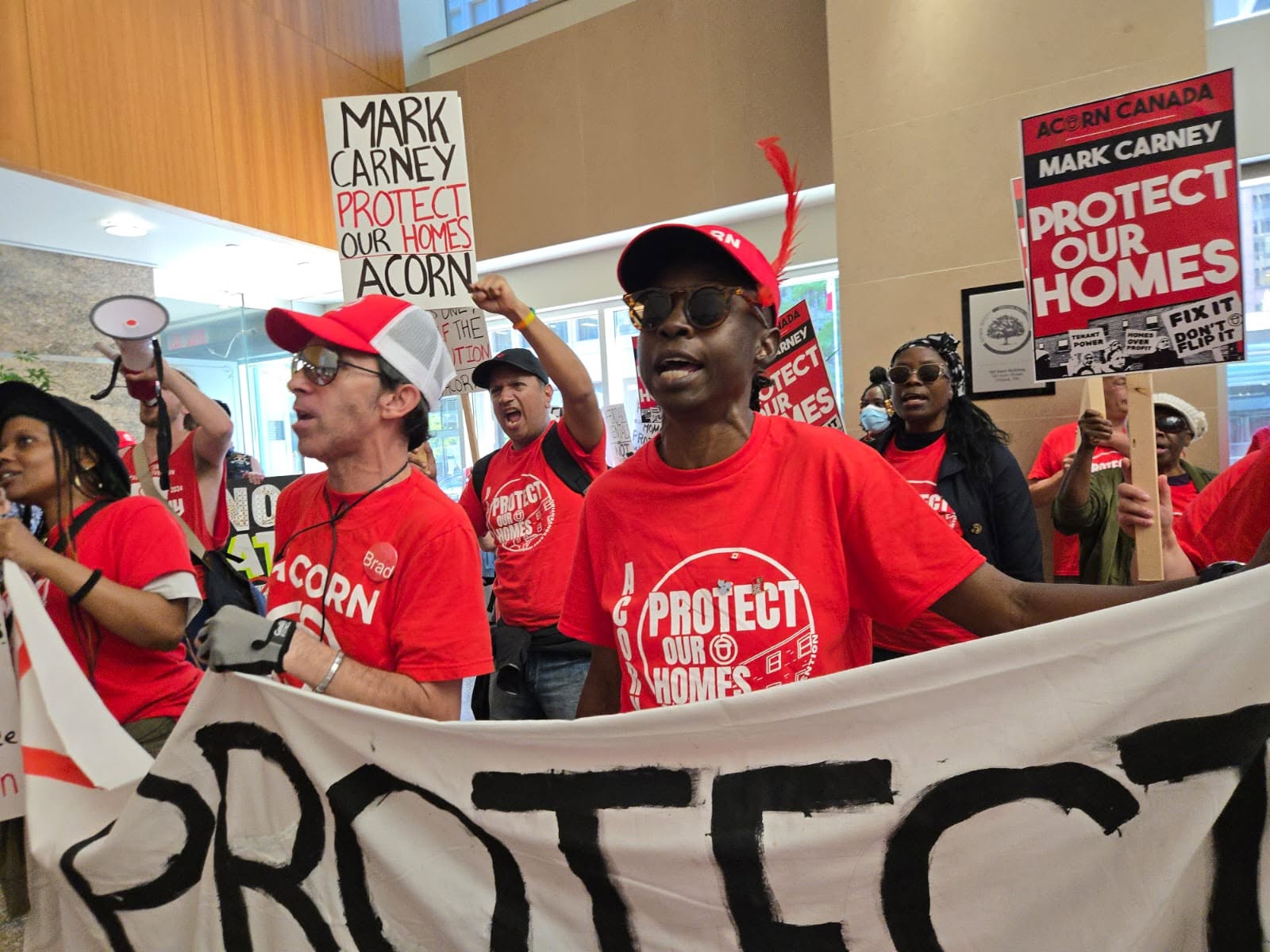
On Monday, June 8th in Ottawa, over 300 ACORN members from across the country gathered on Parliament Hill before marching to the government offices of Housing, Infrastructure and Communities Canada. ACORN Canada is a community union made up of everyday low-to-moderate income people, organizing with more than 190,000 members in 30 chapters across 23 cities. ACORN Canada is the largest tenant union in the country.
The June 8 action organized by ACORN tenant leaders from across Canada was an escalation that came after months of unanswered emails, letters, and phone calls to the federal housing minister demanding a fair say on Canada’s housing policy. ACORN’s demand of the government is simple: give tenants a seat at the table as they consult on the renewal of Canada’s National Housing Strategy. The process, thus far, has been totally secretive and discussed behind closed doors without a voice for tenants in the room.
Housing Supply is Only Half the Solution
Is the government only consulting the housing development industry? When tenants are excluded from the consultation, it is not surprising that the federal government’s housing strategy focuses solely on increasing housing supply. Developers and corporate landlords are the ones who stand to benefit from the construction of new housing that is often exempt from rent controls and affordability requirements. Tenants know that building more luxury and market-based apartments or condos will not fix Canada’s housing problems.
Where is social housing in the government’s rhetoric that seems to only focus on housing supply? Despite evidence that building social housing is more cost-efficient over time than shelters or housing subsidies, the government refuses to build at scale this kind of housing that is in under supply. As a result, Canada’s total stock of non-market housing currently sits at a shamefully low 3.5% compared to most other similar countries, where the OECD average of non-market housing stock is 6.9%.
The most devastating flaw in the federal government’s current strategy is that the loss of affordable housing far outpaces new construction. Between 2016 and 2021, Canada lost 230,000 affordable rental units on the private market. This means that while the government hyper-focuses on building new market-based housing units, Canadians lose 46,000 genuinely affordable rentals annually.
Provincial Laws Enabling the Destruction of Affordable Housing
Much of this loss happens because provincial laws give landlords free rein to destroy housing. In Nova Scotia and Alberta, landlords abuse fixed-term leases that expire annually, instead of rolling over to month-to-month. Under this common arrangement, landlords force tenants to move out so they can hike rents for the next tenant. Alberta, Saskatchewan, and Newfoundland and Labrador do not have provincial rent control policies, allowing landlords to increase rents beyond what tenants can afford.
Landlords also use renovictions or false claims of family moving in to displace tenants and increase rents thanks to provincial policy loopholes, or a lack of policy altogether. In Newfoundland and Labrador, tenants do not have security of tenure, allowing landlords to evict tenants without providing a reason. In Ontario and British Columbia, the provincial governments maintain loose rules around Above Guideline Increases (AGIs) and Additional Rent Increases (ARIs). Housing tribunals, such as the Landlord Tenant Board in Ontario and the Residential Tenancy Branch in BC, rubber-stamp landlord applications to raise rents above the annual guideline and pass the cost of repairs onto tenants. In Ontario, ACORN’s analysis of LTB data found that 80% of AGIs are filed by corporate landlords with billions of dollars in assets.
Hypocrisy of Canada’s Approach to Housing: The Leaky Bucket
The federal government is complicit in this destruction of affordable housing. Programs like the federal government’s Build Canada Homes agency funnel billions of dollars to provinces and cities to build new housing developmentsafter existing units have been demolished. This crisis is rampant in cities like Ottawa, where the Herongate neighbourhood has become synonymous with the term “demovictions” (i.e., the eviction of tenants and demolition of affordable housing to build new developments without affordability requirements).
Herongate, a working-class immigrant community in Ottawa, made international headlines when tenants organized against real estate investment company Timbercreek Asset Management (since rebranded as Hazelview Investments) to fight two mass demovictions the company was undertaking to develop new and unaffordable housing on top of the community. Though ACORN secured some concessions for tenants impacted by future phases of Hazelview’s “master plan,” the City of Ottawa ultimately approved the demolition of hundreds of affordable town homes for luxury rentals. Now, Ferguslea Properties in Ottawa plans to turn Accora Village into “Herongate 2.0.” They are seeking rezoning from municipal policymakers to redevelop Canada’s largest privately owned rental community, which would tear down nearly 1000 three- and four-bedroom town homes where many long-term tenants pay $1,000 per month below market rent. Meanwhile, the City of Ottawa has received $150 million from the federal government to build 1,100 rental units; just 200 of them will be mandated to be affordable for low-income tenants. The purpose of ACORN’s national tenant action was to point out this hypocrisy in Canada’s approach to housing: subsidizing provinces and municipalities without conditions to fund unaffordable private housing developments, while allowing them to destroy existing affordable housing. ACORN is demanding the Prime Minister Carney and the federal government stop using federal funds to fill a leaky bucket.
ACORN’s Demands: Tie Funding to National Housing Standards
If the federal government wants to solve the housing crisis, they must stop ignoring the people living it. ACORN brought the demands of renters across Canada directly to them. Hundreds of ACORN members filled the Ministry of Housing, Infrastructure and Communities Canada lobby on the June 8 day of action, triggering a building shutdown. Thirty of us successfully reached the 11th floor to demand a meeting with the Minister.
Housing Minister Gregor Robertson’s office refused to listen to ACORN’s tenant leaders and threatened tenants with arrest. ACORN members occupied the office and the lobby for over an hour, chanting and flooding staff phone lines with demands that tenant voices are heard. Before leaving, ACORN delivered the formal letter of demands.
ACORN calls on the federal government to ensure that all housing funding must be conditional on meeting national standards that include tenant protections. First, Canadians need rent control with no loopholes. Second, governments need bans on no-fault, no-cause, and bad-faith evictions. Third, fixed-term leases need to end. Finally, renters need guaranteed security of tenure for all.
The government often claims they cannot control the provinces because housing is outside of federal jurisdiction. It is widely known that this is not about jurisdiction, just as healthcare is not administered by the federal government, yet still a major responsibility; the Canada Health Act obliges provinces to provide healthcare for all as a condition for receiving the Canada Health Transfer payment. The National Housing Strategy must do the same. It is time for Prime Minister Mark Carney to lead and make federal housing funding conditional on provinces creating tenant protection policies.
Visit ACORN Canada’s website to learn more and join their National Housing Campaign.