Introduction
Because we use it every day, most people assume that they know how money works. The truth is that money is a strange invention: the way it works today is neither natural nor inevitable, but the product of particular choices that could have been made differently. Like other complex technical systems, the design of our monetary system has profound consequences for our politics and collective well-being.
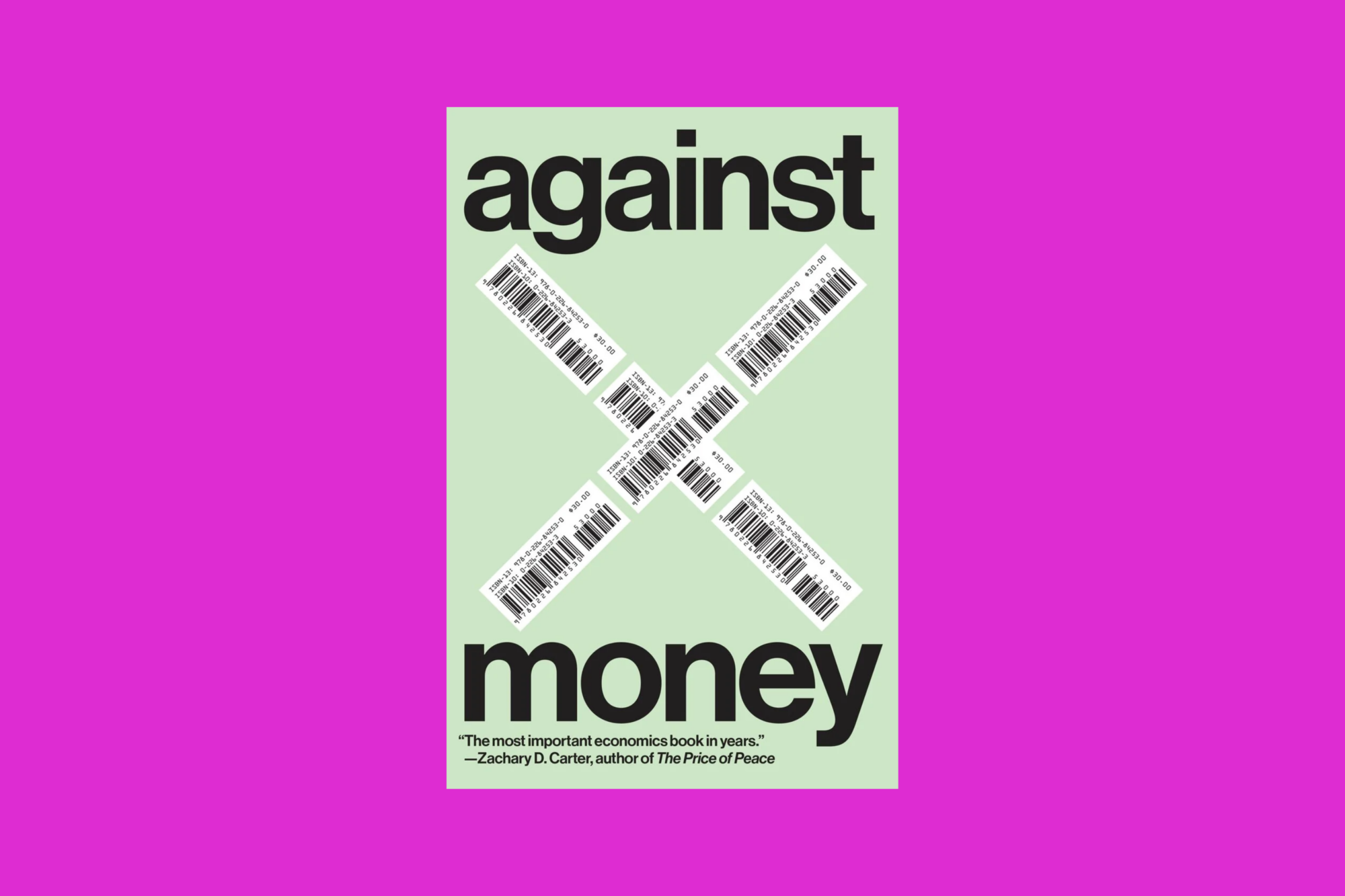
In Against Money (2026, Chicago University Press), economists Josh W. Mason and Arjun Jayadev unpack misleading depictions of money, often found in the business press and introductory economics courses, which collapse the complex and deeply political story of money, credit, and debt into a simple narrative that obscures the laws and institutions that make up modern monetary systems. They argue that money is not a neutral ledger of real exchange values, but a powerful and malleable technology for coordinating the activities of market actors, making possible the complex economic coordination on which modern economies depend.
Against Money is a critical intervention in a field that can feel esoteric and impenetrable, even to those who study and make economic policy. Despite being an accessible entry into the world of money, the book remains a challenging read due to the abstract nature of its subject matter.
Money is Always a Promise
Mason and Jayadev describe the money kept every day in wallets and bank accounts as a promise to pay someone, or something. Cash is simply the most versatile and widely accepted promise. Cash is a tangible monetary technology that can be used for tax payments, can be accepted by businesses for most types of goods or services, and is technically always the liability of a central bank that issues money, redeemable at par in its currency. Historically, this meant that cash was exchangeable for precious metal; today, in “fiat” money systems it is simply redeemable for itself. Similarly, bank deposits, the next most accepted promise, represent a promise a bank makes to you, barring legal time limits, paying you cash on demand in exchange for holding your savings as their asset.
Aside from cash, all financial instruments, such as mortgages, bonds, and more complex securities are legal promises, otherwise known as contracts, which are acceptable and redeemable, depending on the circumstances. These financial instruments are all “money-like” – in practice, there is no binary distinction between money and non-money. However, unlike cash, convertibility between each level of this hierarchy does not always occur at par value. Instruments supported by the strongest institutional guarantees, particularly central bank liquidity, like cash and cash reserves, as well as bank deposit insurance that backs money saved in banks, are the most “money-like” in exchange value.
Seeing money as a promise brings us to Mason and Jayadev’s most critical point: the virtue of money is that it enables people to acquire goods and services by making reciprocal promises that would otherwise be beyond their means. Critically, these promises do not immediately involve exchanging real resources. Mason and Jayadev argue that “the starting point, the atomic unit, is the promise, not the exchange,” suggesting that money, and the financial system more broadly, does not exist to simply facilitate the exchange of real resources.1 Instead, money plays a pro-active function, suspending economic actors’ survival constraint, and enabling otherwise impossible long-term commitments. For instance, trading liquidity today in expectation of a stream of payments over the long run makes possible large-scale projects that require the acquisition of capital goods and mobilization of labour before the resources to finance them have accumulated. The promise of money ensures the fulfillment of these long-term commitments.

The Monetary Production Paradigm
Traditional economic theory organizes around the problem of allocating scarce resources, where a claim on labour or capital frequently comes at the expense of other economic activity. This begins with the assumption that the possibilities for production are set before production takes place. Accordingly, all we can ever hope for is a more productive allocation of finite resources.
Mason and Jayadev instead advance a theoretical framework they call a “monetary production paradigm,” where money is the fundamental driving force of capitalist production. Their approach is inspired by economists such as John Maynard Keynes and Joseph Schumpeter, whose economic theories centralize credit and liquidity. A monetary production paradigm presents the real economy as typically nowhere close to maximum output, also known as the production frontier, meaning society’s resources are far from fully utilized. Economic depressions clearly demonstrate this reality, where productive resources can remain idle.
Economic activity can undoubtedly run into real scarcity situations, but Mason and Jayadev contend that these episodes are merely relative constraints and, more importantly, a signal that one part of the productive system has grown out of sync from its constituent parts.
Amid the Great Depression, Keynes argued that insufficient investment across the economy drives economic downturns. In a slowing economy, producers do not foresee consumers having enough money to maintain or increase existing levels of consumption, so producers refrain from making new investments. Money, in this instance, allows consumers to call forth production through their spending power. Increased consumption, therefore, restarts the cycle of production that makes investments worthwhile. For Keynesians, although the economy cyclically experiences periods of reduced economic activity, there remain infinite possibilities for growth. This potential can be realized through improved coordination and a more equitable distribution of income to encourage consumption, supported by expanding the capacity to borrow and spend. In other words, market actors are not constrained by the need to economize between scarce resources.2 Hence, a monetary theory of production.
However, money is not merely cash in people’s pockets to serve as fresh demand, but a crucial tool for the organization of the supply side of the economy. In other words, money enables societies to plan, invest, and build the infrastructure necessary to sustain modern life. The traditional real-exchange model of the economy assumes that goods trade directly for other goods, and that it is as easy to contract over the future as it is to contract over present matters. There is, accordingly, no need for financial services in this traditional model because the intermediation of credit and debt is not required to facilitate future contracts.
However, the monetary production paradigm holds that these services are crucial because we cannot “contract directly over the future.” Instead, we can only contract over “today’s promises about the future,” with the promises that are more likely to be trusted acting as the foundation for realized investments. Economic activity can undoubtedly run into real scarcity situations, but Mason and Jayadev contend that these episodes are merely relative constraints and, more importantly, a signal that one part of the productive system has grown out of sync from its constituent parts.
Explaining the Bond Market
Mason and Jayadev also argue that the bond market, as a system which elastically expands to mobilize real resources in exchange for promises of repayment, may be underappreciated in mainstream economics but is essential to understanding the financial system. A central organizing feature of bond markets is the interest rate. The interest rate reflects the prices at which creditors will issue new debt instruments to eligible debtors, such as governments and corporations issuing bonds of various maturities. Typically, economists explain the cost of borrowing as the “price of saving.” Much like the famous 1970 Stanford Marshmallow Experiment, where children prevented themselves from eating a marshmallow in exchange for receiving two marshmallows later, interest is commonly understood to be compensation paid in the future to someone who holds resources but relinquishes their claim to them in the present, thereby making those resources available to someone else.
Seeing interest as the price of saving corresponds with the “loanable funds” theory of interest. This theory assumes that all investment is funded by a fixed pool of savings, where increasing the amount of money that people save will increase the amount available for investment. The interest rate, then, moves up and down based on the amount of savings available and the amount of investment desired. Financial analysts and Keynesian economists argue, however, that this widely held heuristic has it backwards.
As banks produce new money whenever someone borrows or lends, this credit is extinguished when those loans are repaid.3 From here, the liquidity theory of the interest rate advanced by Mason and Jayadev suggests that, “it is not the interest rate that adjusts to keep saving and investment equal to each other; rather, it is income and output.”4 When a business sees an opportunity to make a new investment, it seeks funding from a bank or financial institution. In practice, a bank does not weigh the decision to invest against its available savings; it makes the loan if it can expect that the investors’ returns will overcome the prevailing interest rate since the bank can always borrow at that rate from the central bank. As the authors helpfully put it, “every credit card transaction is a moment of elasticity”, enabling people to demand production or consumption today.
For the whole economy, the level of savings is then determined by the level of investment: one person’s consumption is another person’s income, and the decision to save rather than invest will always reduce the overall level of income across the economy. For the authors, it is, “not the interest rate, then, that adjusts to keep saving and investment equal […] It is income and output. When people attempt to consume less, the result is […] lower income.” Increased savings can only follow from changes in investment; the reverse does not happen as savings do independently cause more investment.
Returning to the loanable funds theory, proponents argue that the introduction of additional money into economic circulation automatically leads to price inflation. However, from a Keynesian perspective, there are often unrealized opportunities for investments during the business cycle held back by insufficient credit provision. Unless the economy is fully using up its real resources, extending credit, and therefore adding more money into circulation, would also enable more income to circulate, calling forth new production as people spend more, more income is created, and there is more reason to invest.
What really determines interest rates, then, is the demand for liquidity like cash or credit. If interest rates were a function of the stock of available savings, as the loanable funds theory would suggest, they would not move so erratically during periods of financial crisis. In reality, it becomes more expensive to borrow during moments of crisis because liquidity is priced at a premium, especially when asset values crash while being converted to cash at an accelerated rate to save what is left of their value. Across the economy, the cost of having money tied up in longer term investment therefore rises sharply while short-term and prospective long-term investment contracts as investors simultaneously pull back from new commitments in response to higher interest rates. Interest rates, therefore, are a function of composite expectations about the future and are not set by the underlying stocks of savings.
Beyond illiquidity and the concern that an asset may not be as reliable as cash for immediate payments, interest also compensates for the risk that the asset’s price will change, thereby affecting the holder’s wealth. As a result, market participants’ expectations of future asset prices influence current prices, giving interest rates a circular, self-confirming — or, in Mason and Jayadev’s terms, “conventional” — character.

So What?
The elasticity of the money supply, or the change in the amount of money in response to changes in other economic variables, matters to determine who defaults and who survives during a financial crisis or economic shock. The result of money supply elasticity is apparent in daily bond market activities that issue debt, but it also has deep political consequences. From countries to individual lenders, policies set by banks, central banks, and international financial institutions such as the International Monetary Fund determine repayment timelines and the severity of the consequences debtors face for failing to repay.
Like many other technologies, money is not neutral and often favours those with power.
Under a financial market determined by collective expectations of the future, price signals alone do not determine what is produced. Instead, huge leaps of collective production are achieved alongside speculative investments in every financial bubble, due to flashes of coordination where certain actors are provided with very flexible funding conditions. When banks loan incredible amounts of money to AI companies to build data centers, it is not happening at the expense of other lending. Rather, this is a decision made independently using the banks’ ability to make offsetting “promises” with their money that will be settled once these companies become more profitable.
These dramatic moments of monetary coordination are also haphazard. Our monetary system is a very human one, where certain people or institutions are deemed trustworthy and can get preferential access to credit while others are excluded. In practice, trustworthiness is determined institutionally and it is often up to the government to decide who has power to issue and access credit.5
The deeper story that is only referenced briefly throughout the book – the political economy implied by this new theory of money and credit – is written in law. Like many other technologies, money is not neutral and often favours those with power. In a key line from the book, the authors explain that banks effectively function as central planners, with the additional power to allocate not yet existing goods, by extending credit based on their view of potential returns to come. Since money always enables a claim on real resources, it provides power in the real world. How it does so, however, is a complicated story mediated by legal and political institutions. The task for scholars and policymakers is to examine these institutions in detail and consider how they could better serve the public interest.
Conclusion
Against Money is an ambitious attempt to pull the general reader into the institutional foundations of money. It explores how monetary institutions determine whose promises are trusted and supported and whose claims are deemed credible. Investigating the political economy of money, credit, and debt is an immensely important undertaking, but one that is also deeply theoretical and, at times, esoteric. As a result, this introductory book necessarily leaves aside the more nuanced legal, philosophical, and historical questions surrounding money’s design.
The details of bank lending, the international hierarchy of different forms of money, the mechanics of monetary institutions, and the debates over the private versus public role in money creation are all important topics for readers to explore if they find themselves engaged by Against Money. These sub-topics have profound implications, which include the distributional consequences of our current set of policy tools tasked with managing inflation, and the political and economic consequences of delegating substantial authority over the creation and allocation of credit to commercial banks. The authors’ applied work, such as J.W. Mason’s writing about the housing market, is one fantastic starting point for appreciating the consequences of their theory of money for contemporary public policy debates.6
The book ends with a general critique of the role that money plays in our lives, and a fantasy of a future without money. Focusing on the privatization of this powerful tool for social coordination by the contemporary banking system leads the authors to dream of a future free of money and the coercive elements of capitalism. However, we think the most important takeaway from this book, one with more immediate implications, is its reminder to think seriously about the specific ways that our modern monetary systems can be used and transformed to serve greater public purposes.
Notes
- J. W. Mason, “Talking about Against Money at the New School,” Substack newsletter, Money and Things, March 23, 2026. Available online. ↩︎
- Josh W. Mason, “Climate Policy from a Keynesian Point of View,” Heinrich Böll Stiftung | European Union, 2022. Available online. ↩︎
- Perry Mehrling, The New Lombard Street: How the Fed Became the Dealer of Last Resort (Princeton University Press, 2011) ↩︎
- “The General Theory Ch.15 – by Alex Williams,” accessed June 11, 2026. Available online. ↩︎
- Christine Desan, Making Money: Coin, Currency, and the Coming of Capitalism (Oxford University Press, 2014) ↩︎
- J. W. Mason, “After the Rent Freeze | JW Mason,” Phenomenal World, February 10, 2026. Available online. ↩︎