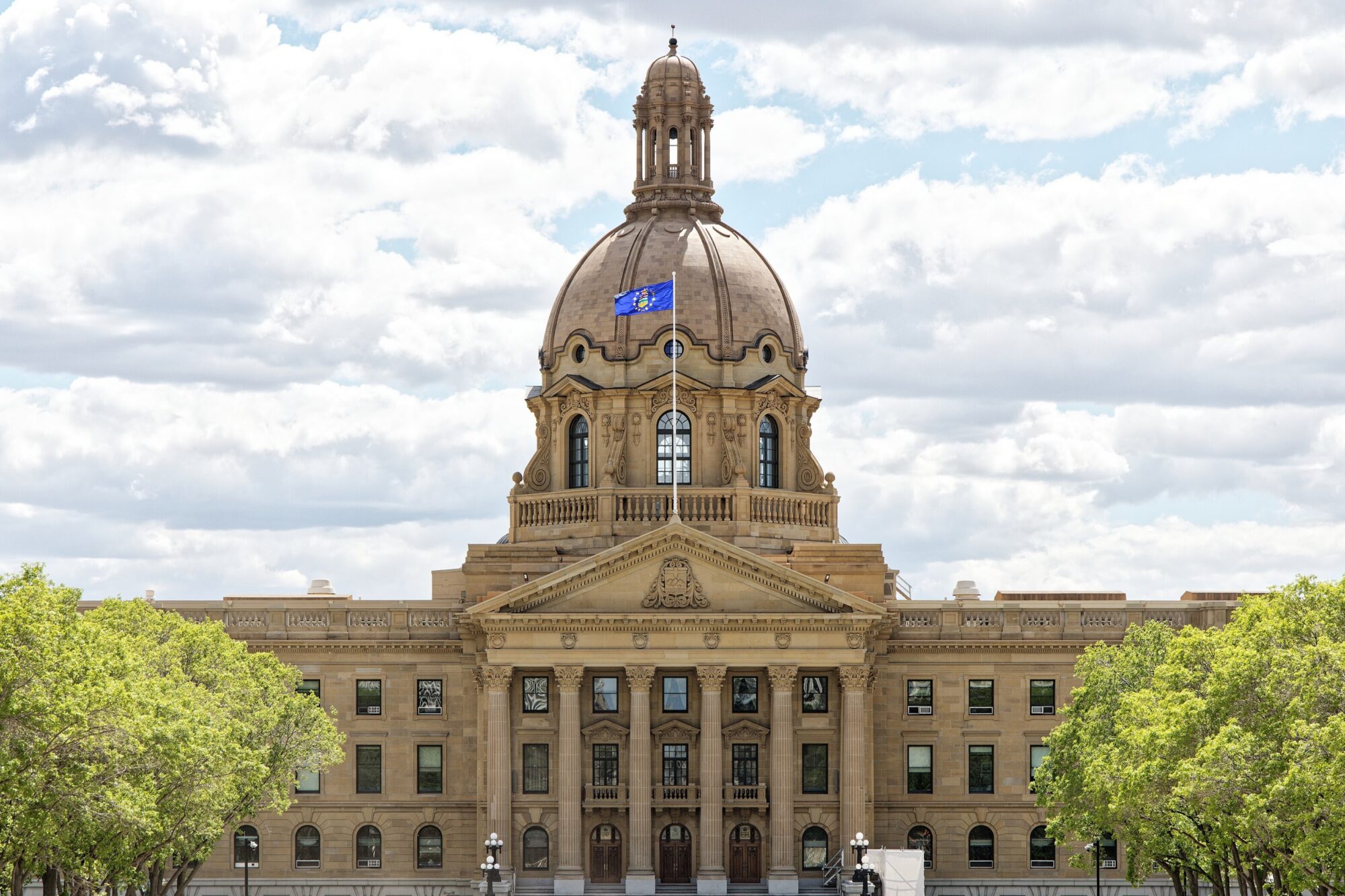
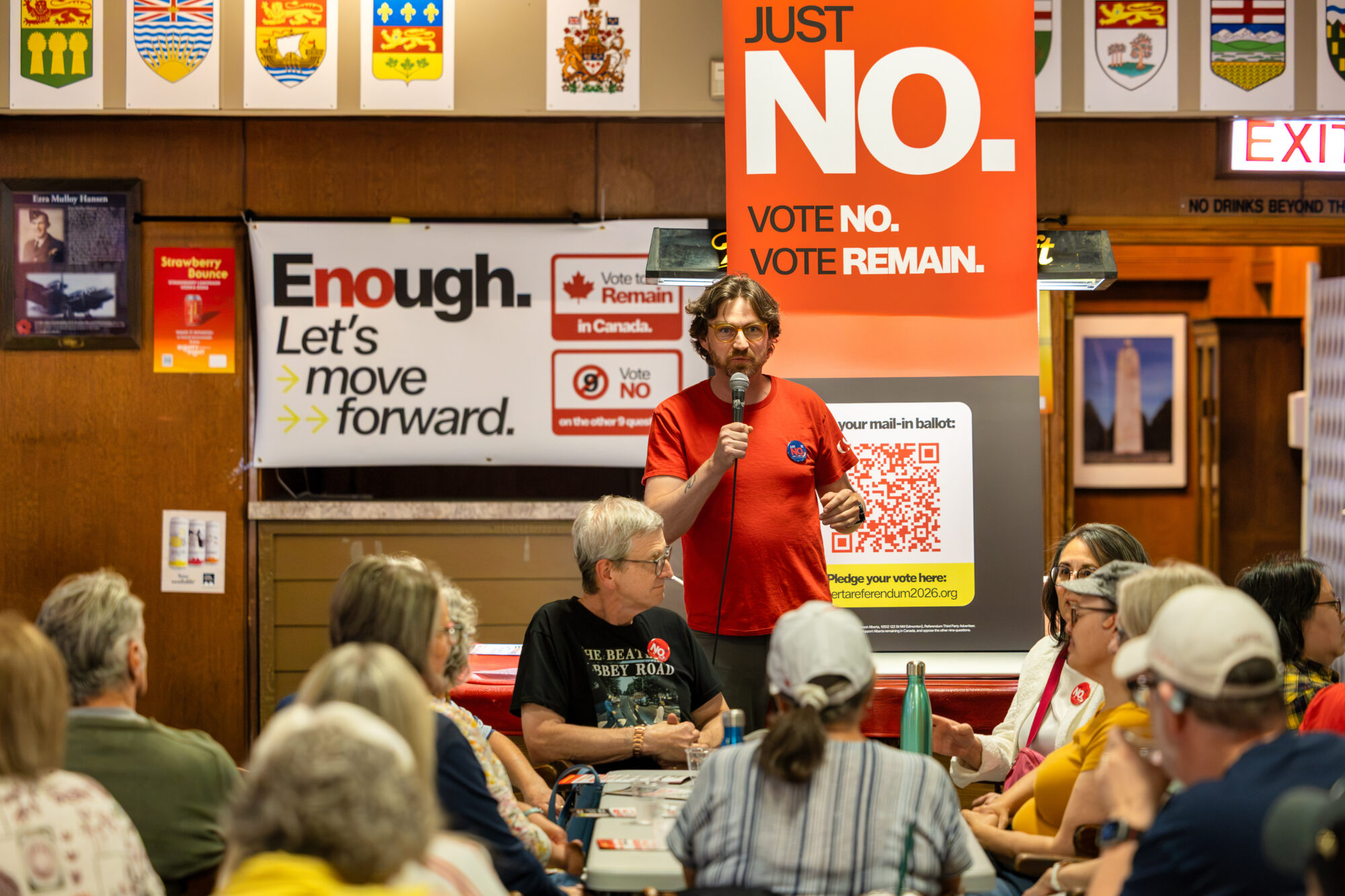
Progressive Albertans are on the front lines organizing for the referendum fight that Premier Danielle Smith, and her United Conservative Party government, have imposed upon the people of Alberta on October 19. It is not just Alberta separatism that is on the table: there are 10 questions being put to Albertans this fall that target immigrants and the province’s legal authority over the federal government.
There are mechanisms in Alberta for citizen engagement that would, through petitioning, force the government to call referenda on questions designed by the public, but this decision did not happen through these public mechanisms. A previous attempt to petition for an independence referendum was deemed unconstitutional by a federal judge earlier this spring as no consultation took place with First Nations whose sovereignty would be affected by this process. Instead of committing to democratic processes, Smith’s government, through an ‘Orders in Council’ executive decision, has authorized these referenda to take place. No mass of real public urgency forced these issues to referendum votes.
This is a government project, designed by the Premier and her Cabinet, foisted upon Albertans at a time where, like in other places, the province is seeing rising costs, a crisis in healthcare and in classrooms, and real serious worries about U.S. President Donald Trump, tariffs, and the economic effects for Alberta and the rest of Canada. Smith has used these crises and directed these dubious referenda votes as an opportunity to disrupt public services and democratic institutions from operating in the public interest.
This referendum should not come as a surprise to many watching the Alberta government. For Premier Smith’s libertarian ideological leanings, referenda are the preferred mechanism for bypassing representative democracy – but the mechanism is typically invoked when there is a critical mass of public outcry for a different democratic process. The authoritarian hook to this libertarian exercise imposed on voters also tracks with the Alberta government’s efforts to privatize healthcare and education despite opposition to two-tier systems.
Furthermore, Alberta separatism has been fixation for Smith’s UCP government. Greater control over policing, taxation, the justice system, energy and emissions, pensions, and the administration of social programs has been the goal that separation would facilitate. If full separation is not possible, then “sovereignty” of Alberta within Canada would be the next best thing.
Immigration, Constitution, and Independence on the Ballot
Here lies the hedged bet on sovereignty within the 10 questions being put to Albertans on October 19 if the question on independence fails. These questions on the ballot fall into three general categories. The first five questions target immigrants as the reason for Alberta’s budget challenges, youth unemployment, and rising healthcare and education costs. The next four questions focus on sweeping constitutional changes to establish provincial supremacy over several matters, ranging from provincial appointment of all judges to cutting all strings attached to federal program funding, including healthcare.
The final question receiving the most attention in Alberta and across Canada asks:
10. Should Alberta remain a province of Canada or should the Government of Alberta commence the legal process required under the Canadian Constitution to hold a binding provincial referendum on whether or not Alberta should separate from Canada?
Despite the preoccupation with the final question, Canadians should know about the serious implications across the ballots handed out for the October 19 referendum.
Immigration Questions
Though immigration is a federal policy issue, the Smith government has added reactionary and incendiary questions to the referenda ballot questions seeking to limit access to services for newcomer Canadians in the province. The questions are leading and not straightforward, requiring much clarification on their intent and the policies the provincial government would change if given the mandate. The first ballot question reads:
1. Do you support the government of Alberta taking increased control over immigration for the purposes of decreasing immigration to more sustainable levels, prioritizing economic migration, and giving Albertans first priority on new employment opportunities?
Asking Albertans for a vote on “decreasing immigration to more sustainable levels” contradicts the provincial government’s own criticisms of the federal government for reducing immigration levels. Premier Smith herself only three years ago called for boosting the number of newcomers and handling anti-racism in the province to fill workforce shortages in the oil and gas industry, service industry, education, and healthcare, in particular.
Pairing with the contradictions of the first question comes the following ballot questions:
2. Do you support the government of Alberta introducing a law mandating that only Canadian citizens, permanent residents, and individuals with an Alberta-approved immigration status be eligible for provincially funded programs such as healthcare, education and other social services?
3. Assuming that all Canadian citizens and permanent residents continue to qualify for social support programs as they do now, do you support the Government of Alberta introducing a law requiring all individuals with a non-permanent legal immigration status to reside in Alberta for at least 12 months before qualifying for any provincially-funded social support programs?
4. Assuming that all Canadian citizens and permanent residents continue to qualify for public health care and education as they do now, do you support the Government of Alberta charging a reasonable fee or premium to individuals with a non-permanent immigration status living in Alberta for their and their family’s use of the healthcare and education systems?
It is unclear what an “Alberta-approved immigration status” would mean, though it does imply that the provincial government could create a new class of citizenship that decides who does not have access to public services despite paying into those systems. Temporary workers pay into the system they receive services like healthcare from, and businesses in Alberta benefit from a healthy workforce they already pay taxes for. It also begs the question as to how many adult temporary foreign workers are adding to overcrowded and understaffed public elementary school classrooms. Making newcomers pay more for services like healthcare that they use less of and already pay for is not going to pay for funding cuts to the public health system.
Shifting the blame for Alberta’s policy failures on to newcomers who, only a couple of years ago, were celebrated for their contributions to Alberta’s life and economic prosperity distracts from the real failure of this government’s agenda when it comes to the privatization of the same social services on the ballot.
These ballot questions reflect an alternative reality to the real the struggles Albertans are facing like the cost-of-living shock and the U.S. Trump Administration’s threats of annexation. The final immigration question on the ballot asks:
5. Do you support the Government of Alberta introducing a law requiring individuals to provide proof of citizenship, such as a passport, birth certificate, or citizenship card, to vote in an Alberta provincial election?”
This ballot questions reads like it came from the US news where this headline scare is commonplace. Meanwhile, Alberta separatists group offer a greater threat to democracy and trust in electoral systems, leaking the personal information of ordinary Alberta citizens. It would appear the mistrust in Alberta’s democracy is largely coming from the inside. Instead of concern for Albertans exercising their democratic rights, perhaps more scrutiny around US interference and separatists in Alberta’s democracy should be on the ballot?
Constitutional Questions
On the constitutional questions on the ballot, Premier Smith’s government is attempting to take political control of the judiciary, refusing participation in Canada’s federal systems, and limiting cooperation with other provinces. The first of the constitutional suite of questions asks:
6. Do you support the Government of Alberta working with the governments of other willing provinces to amend the Canadian Constitution to have provincial governments, and not the federal government, select the justices appointed to provincial King’s Bench and Appeal courts?
While the Alberta government looks to determine who has access to health care in the province, at the same time, they have asked for more authority over judges who would otherwise provide a check and a balance against government overreach in the unfair delivery of nationally mandated public services. The eighth and ninth questions ask:
8. Do you support the government of Alberta working with governments of other willing provinces to amend the Canadian Constitution to allow provinces to opt out of federal programs that intrude on provincial jurisdictions, such as healthcare, education, social services, without a province losing any of the associated federal funding for use in its social programs?
9. Do you support the Government of Alberta working with the governments of other willing provinces to amend the Canadian Constitution to better protect provincial rights from federal interference by giving a province’s laws dealing with provincial or shared areas of constitutional jurisdiction priority over federal laws when the province’s laws and federal laws conflict?
The provincial government’s recent Bill 11 attacks public healthcare by establishing the necessary framework for the establishment of two-tier, American-style healthcare in the province, which includes space for private insurance schemes. This system would be in direct conflict with the public healthcare delivery mandate of the Canada Health Act. Alberta’s government would certainly need a judiciary that does not recognize federal legislation to legally deliver privatized health care.
This defies most Albertans who support publicly delivered healthcare. 86% of Albertans agree that universal health care based on a person’s need, not how much money they have, is a core Canadian value. 53% of Albertans are very concerned about the future of public health care. This constitutional question is effectively a health care and education question, shifting the blame for their provincial failures, this time, to the federal government, and asking Albertans to enable the Danielle Smith government to privatize public services.
Provinces are not autonomous from Canada and even question 7’s ask related to Senate abolition would not make Alberta autonomous from the federation, as a hedge against the separation vote’s failure. No matter where you live in Canada, the working class should have the same rights and privileges like the right to vote and access to services, or it is a betrayal of the very fabric and what it is to be a citizen of this country.
The “Independence Question”
Question 10, ultimately and confoundingly, does not ask voters whether they want Alberta to separate from Canada or not. The choices are:
- Alberta should remain a province in Canada; or
- The government of Alberta should commence the legal process required under the Canadian Constitution to hold a binding provincial referendum on whether or not Alberta should separate from Canada.
The question on the ballot is formulated as such due to the court challenge by First Nations, including Athabasca Chipeywan First Nation, Blood Tribe, Piikani First Nation, and Siksika First Nation, that led to the rejection of the earlier separatist petition by Elections Alberta on the grounds that the question would have would have violated the numbered treaties that cover Alberta. Provincial control over the judiciary, as the previous constitutional questions would imply, could overcome this legal dead end for separatism and privatization. Even with executive control to reform Alberta’s judiciary, this transformation will need time.
A second binding provincial referendum must take place later. While trying to appear on the side of “remain” on the question, Premier Smith has stated that were a vote to commence the process for a binding provincial referendum on separation were to succeed, she would rush to move it forward which would need to include the mandate for judicial reform and constitutional secession. Were question 10 to fail, but the constitutional suite of questions to succeed, the groundwork is still laid out for future separatist efforts.
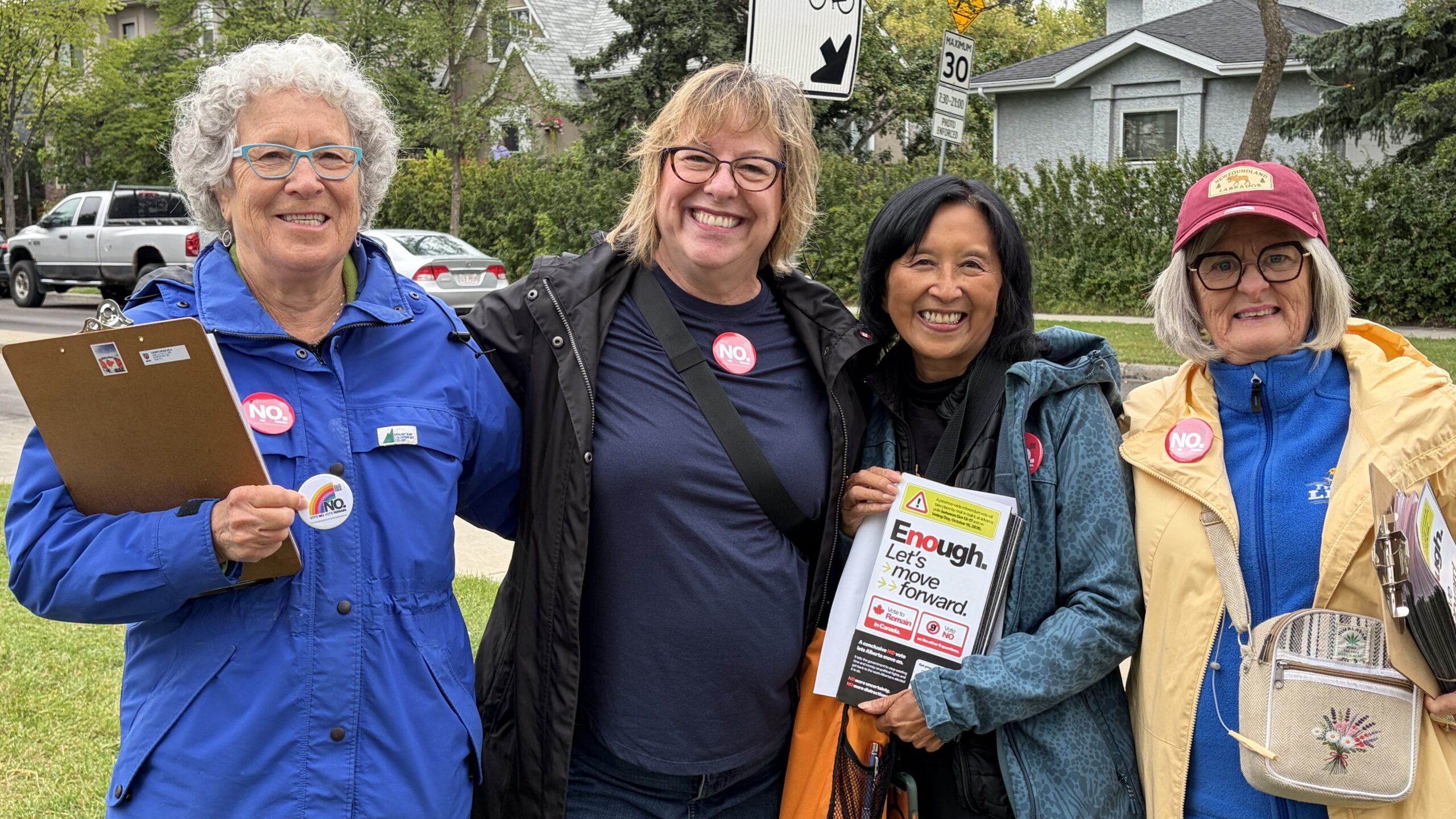
Enough Division: The Campaign to Vote No to Remain
At a time when Albertans are worried about healthcare, rising costs, and jobs, Premier Smith’s government is asking Albertans to spend time and money on political fights that won’t make life better for Alberta families. It is distracting citizens who would otherwise be advocating for better education for their children. The referendum is an outlet for people who are angry about the cost of living, and how they’re feeling more generally about how things are going in Alberta but channelling that outlet into an effort that will not solve these problems.
The ten ballot questions are not ten separate political debates. The referendum is designed by Danielle Smith to enable Albertans struggling with the cost-of-living crisis to blame their neighbours instead of those in power. She blames the previous government for coal mining, the federal government for lack of investment in extractive industries, and newcomers to Alberta who answered her “Alberta is calling” recruitment campaign for policy failures. Taken together, they represent a political agenda that divides people, scapegoats communities, and keeps Albertans fighting with each other instead of demanding action on the problems affecting their everyday lives.
Therein lies the danger: Smith and the separatists have found a formula that is working, at least for now. The sentiment that democratic politics is not working for everyday citizens can be found across Canada and is being seized upon by the far-right. In Alberta, this sentiment that through separatism is finding common cause with authoritarian tendencies. The contents of the immigration and constitutional ballot questions, bundled with the independence question, denote the political tendencies this referendum is coming from.
Saying enough is enough is at the core of Public Interest Alberta’s (PIA) campaign to organize citizens to vote “No” and vote to remain and to defend the human rights of all Albertans. The frustration of fair-minded Albertans is palpable and, in this moment, we are focusing that feeling into a highly organized and passionate rejection of the politics of division.
PIA has pulled together a large coalition comprised of unions and civil society actors, non-profits, First Nations cultural communities, and other engaged citizens to mount a campaign focused on speaking with as many non-Conservative voters as possible across the province.
We believe that at the end of the day, Albertans will not let ourselves be divided by a cynical politics that tries to distract and scapegoat people from the real policy failures of this provincial government’s push for economic shocks, privatization, and profit. The “Together – No!” campaign is organizing town halls, events, canvassing blitzes, phone canvasses, organizers training, and media content to push back against the separatist narrative that things will get better under a more authoritarian and privatized Alberta.
In early September, PIA held campaign launch events in Calgary, Lethbridge and Edmonton, organizing hundreds in barnstorm-style events to rally volunteers and platform dozens of speakers who are on the front lines defending their communities against the threats this referendum is presenting.
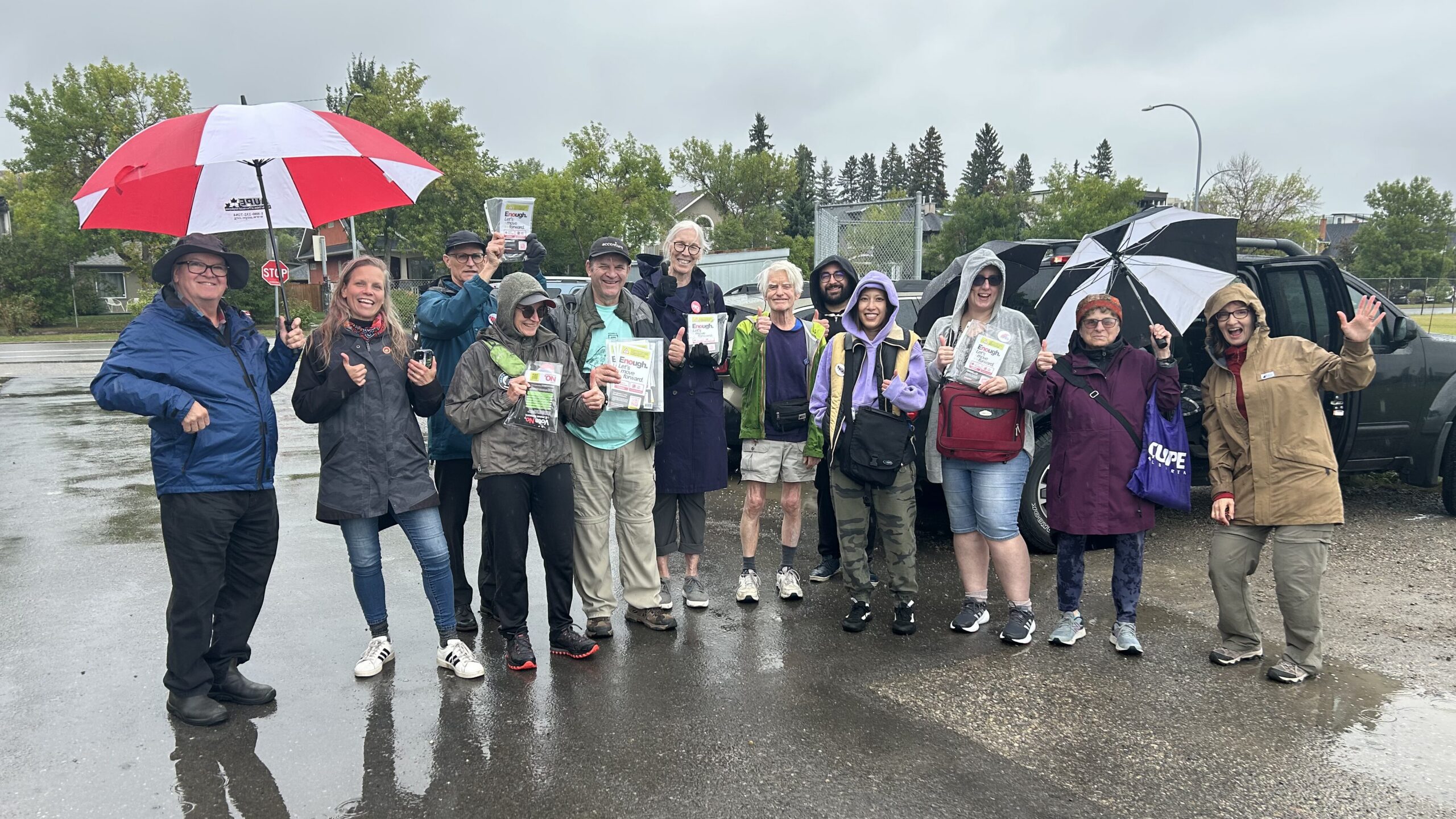
PIA’s campaign has so far succeeded in signing up hundreds of volunteers to canvass, phone bank, and inform Albertans across the province about why we need to vote “No” and get back to the real issues. Through massive early GOTV efforts, and more than 685,000 mail-in ballots were requested by Albertans. Furthermore, PIA’s internal numbers show that more Albertans are being persuaded to vote “No” against the divisive immigration and constitutional questions, in addition to voting “No” to remain. PIA has accomplished a lot in a few short weeks, but there is much to do in this final stretch.
Thousands of pledges to vote “No” have been signed at albertareferendum2026.org and on the doorstep. With the threats to Alberta’s newcomer communities, the campaign is translating as much material into 12 other languages to reach and mobilize them to ensure that all Albertans learn about the upcoming vote and the importance of voting no to the ballot questions. This campaign is optimistic that we can deliver a positive message to the rest of Canada that Alberta is so much better than what Premier Smith wants all of us to believe.
Even after the October 19 referendum, Albertans will still need to put up a fight against cuts to healthcare and education, further attacks on the rights of newcomers, and the provincial government’s neglect of the real cost of living crisis. There is no more time for scapegoats and excuses. PIA is working to bridge the gaps, organizing in communities across Alberta to build a better province rather than breaking things apart.
Find FAQs on the October 19 referendum, learn more ways to support the campaign, and join events at albertareferendum2026.org