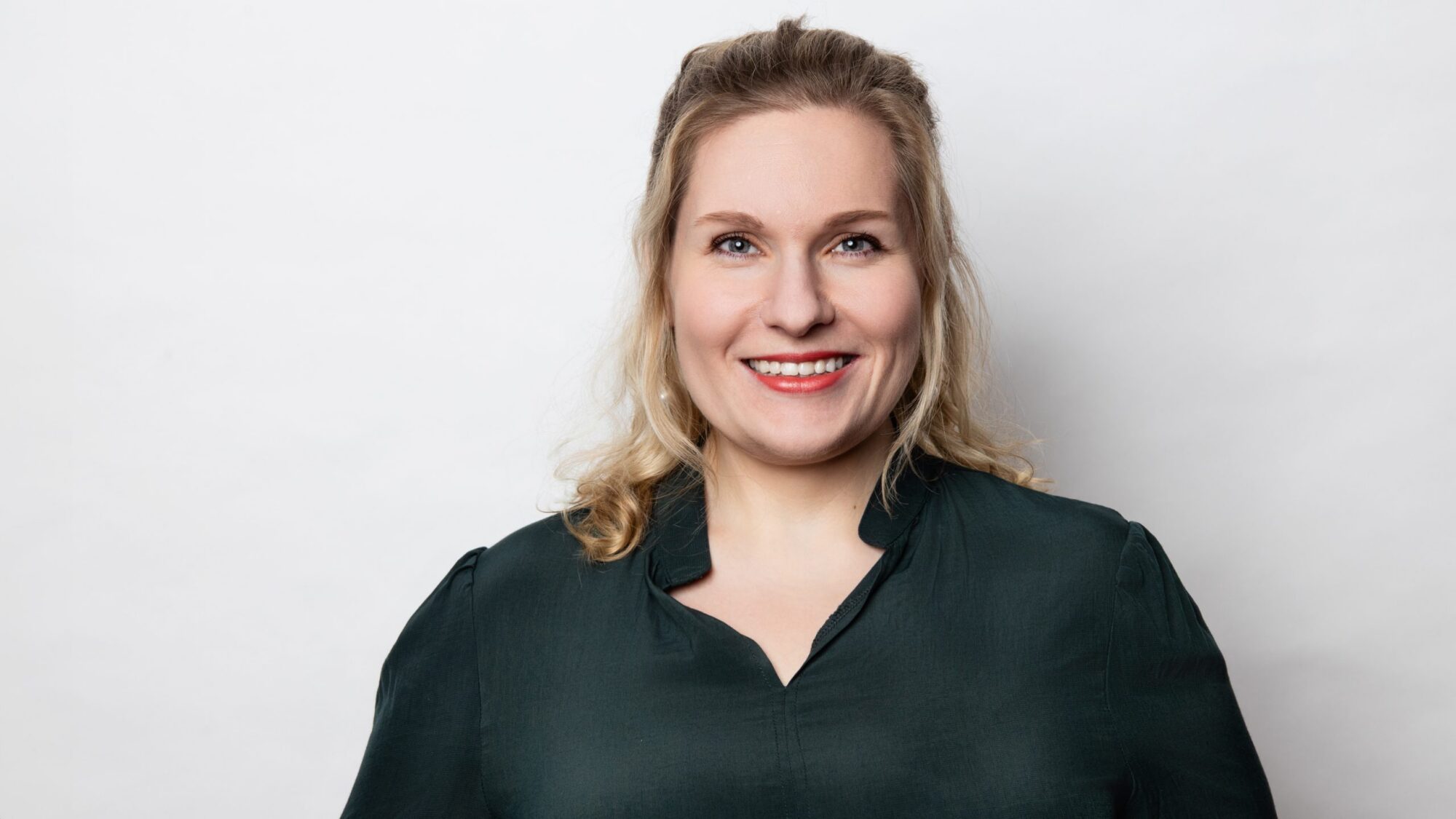
Annemarie Wolff is a member of the State Parliament of Brandenburg, Germany, where she is the spokesperson for the Governing Social Democratic Party (SPD) parliamentary group on combating right-wing extremism and youth, among other roles. She first joined the SPD through the Young Socialists (Jusos) wing, campaigning for better transit connections in her hometown. Today, she is a member of the Brandenburg state legislature, and one of the youngest current Members of State Parliament (MdL).
The challenges in Brandenburg, a former state of the East German Democratic Republic that surrounds today’s Federal capital of Berlin, are reaching a crisis point. In the three decades since the fall of the Berlin Wall and the reunification of East and West Germany, the SPD have governed this state. However, the far-right Alternative for Germany (AfD) party, designated by Germany’s federal domestic intelligence agency (Verfassungsschutz) as a right-wing extremist organization, leads against the SPD in current public opinion polling.
The 2024 state election produced a coalition government between the SPD and the third-place “Sahra Wagenknecht Alliance – Reason and Justice” (BSW) party, built around its “diagonalist” leader, formerly of Germany’s Left Party (Die Linke) who formed a new organization with nationalist, socially conservative tendencies. The AfD came a close second to the SPD in this election, winning 30 of 88 seats compared to the SPD’s 32 seat share. The collapse of the SPD-BSW government in January 2026, due to internal rifts within the BSW party, made way for a centrist coalition government between the conservative Christian Democratic Union (CDU) and the SPD. Meanwhile, support for the AfD since the last state election has risen to 10 percentage points over the Brandenburg SPD. Brandenburgish youth are in a precarious situation, with polling suggesting that youth are siding with the far-right AfD, and other young people feeling endangered around their peers who are emboldened by the far-right cultural wave. New crime statistics demonstrate a 25 percent year-on-year increase in people that have become victims of right-wing violent crime, reaching a peak of almost one attack-a-day in Brandenburg.
While youth become increasingly pessimistic about the future, succumbing to the nihilistic politics of the AfD, MdL Annemarie Wolff remains hopeful, but wary. In this interview, Wolff has stark warnings for Canada and advice on what socialists must learn from the situation in Brandenburg.
This interview was originally conducted in German and has been interpreted and edited in English for clarity and brevity.
Mathis Cleuziou: Would you please briefly introduce yourself to Canadians?
MdL Annemarie Wolff: I am Annemarie Wolff, a member of the Brandenburg State Parliament for the SPD. In the 2024 election, I ran as the lead candidate for the Young Socialists (Jusos) wing of the SPD and entered the state parliament through the party list for the state of Brandenburg.1 However, I took a lot of time with this decision to run for political office because becoming accustomed to my political home was important to me. Long before becoming a MdL, I joined the SPD in 2011 in my very early 20s to advocate for an S-Bahn [suburban commuter train] connection from my hometown to other towns in Brandenburg and to Berlin. After joining the party, I became Jusos chair of my electoral district, and a few years later I was elected chair of the Jusos for the state of Brandenburg.
I remained active in my local party branch at the sub-district level, in municipal politics, and in working groups at the state level. Traditionally, we call this the “Ochsentour” (ox tour); a politician’s slow, deliberate and thoughtful rise to political office from the neighbourhood-level onwards. At the same time, I stumbled into many roles on this path. Then I wanted to run myself, in my electoral district, where I had always supported candidates by hanging posters, distributing flyers, and participating in discussions. While supporting campaigns in previous years, I realized that we weren’t present with people on-the-ground. I felt that people did not feel seen or heard by my party. So, I decided to do things differently.
During my campaign in 2024, I went door-to-door, played cards with elderly women, and listened to their life stories, worries, and hardships. We laughed a lot, sometimes cried, and one thing became clear: especially in rural areas, people are very much alone. That’s why it’s so important that politicians come down from the ivory tower, or step out of our echo chambers, so that we don’t cede public space to right-wing extremist forces. Where democratic presence is lacking on-the-ground, a representation vacuum emerges that right-wing extremist actors like the AfD will fill with simplistic narratives. What I’ve had to learn through these experiences then is that political decisions often require a very long breath. Despite promises from state politicians, the S-Bahn connection still does not exist. Democratic resilience therefore requires visible accessibility, continuous dialogue, and serious engagement with concrete problems!
MC: What are your responsibilities in the Brandenburg State Parliament and for the SPD?
AW: In the state parliament, I am the youth policy spokesperson for the SPD parliamentary group and spokesperson for combating right-wing extremism. I’ve also been the point person for gaming and digital participation because digital spaces have now long been a part of our world, especially for young people. Within the SPD, I also take on other party responsibilities at the party level – I’ve been a Member of the SPD Brandenburg State Executive Committee since 2018. In short, working through the SPD Executive Committee I am able to set the agenda there and ensure that youth policy, defending democracy, and modern participation are not just nice-to-haves, but are central priorities.
MC: What is the situation in Brandenburg and why is a spokesperson for combating right-wing extremism so important for the state?
AW: Brandenburg has had a history of right-wing violence since 1990. The “baseball bat years” were a time when right-wing and racist violence were a part of everyday life in many places in reunified East Germany. Many people felt they were left behind to fend for themselves against these attacks. From this experience, Brandenburg started relatively early in building permanent structures against the far-right, such as the “Tolerant Brandenburg” action plan and advisory services across the region that included mobile counselling teams to provide concrete support to municipalities, schools, and initiatives.
Particularly formative for our region in defending ourselves against the far-right was the racist murder of Amadeu António Kiowa, who was brutally attacked by a right-wing group in the town of Eberswalde in November 1990 and died a few days later. We also saw arson attacks on refugee shelters and concentration camp memorials, including the barracks of the Jewish Museum at the Sachsenhausen concentration camp in 1992. The 2000s saw neo-Nazi attacks on young people and additional memorial sites; around 2015, anti-refugee asylum sentiments escalated with the so-called “Pegida” [Patriotic Europeans Against the Islamisation of the West] movement’s influence. Right-wing mobilization often attaches itself to societal debates and crises, and right-wing ideology here isn’t just a fringe phenomenon, it is strategically woven into everyday life by the AfD and its right-wing sphere through the right-wing periphery, social media, local campaigns, intimidation, and hate crimes. We’re seeing rising numbers of right-wing crimes (in 2025, around 2,840 right-wing crimes were registered in Brandenburg) and a normalization of misanthropy. Degrading slogans, threats, and open hostility are becoming more routine in many places; the boundaries of what can be said and done are shifting.
At the same time, democratic engagement at the grassroots level is coming under increased pressure. Mayors, volunteers, and engaged young people in their own organizations and alliances experience personal attacks, digital hate, and direct intimidation. Some are reducing their involvement; others are withdrawing entirely because systemic protection and support is lacking. This is exactly where politics is called upon. It must take clear positions, strengthen protective structures, support those affected, and make clear that democratic engagement will not be left behind.
MC: What are the Alternative für Deutschland & Generation Deutschland?
AW: The Alternative für Deutschland (AfD) is a federal and state political party founded in 2013. Initially conceived as a Eurosceptic protest party, it has shifted significantly to the right since then, including strong ethno-nationalist currents and increasing radicalization within parts of the party. As a result, the AfD is monitored by Germany’s domestic intelligence agencies. In Brandenburg, the AfD state association has been classified as a “confirmed right-wing extremist organization” since August 2025.
Generation Deutschland (GD) is the new youth organization of the AfD, founded in 2025 after the previous youth organization, the Junge Alternative (JA), was dissolved by the federal party. Before its dissolution, the JA was relatively organizationally independent as an association and was classified by the domestic intelligence agency as a “confirmed extremist effort.” This classification was also legally upheld in court in 2024. In early 2025, the AfD formally separated from the JA at a party conference and decided to build a new youth organization more closely tied to the party. Shortly thereafter, the JA decided to dissolve itself by March 31, 2025 amid debate about whether a ban on the association would be imminent. Generation Deutschland is not just “a new name,” but part of a strategy: new structure, more firmly under party control, and with many personnel and ideological continuities. What’s particularly relevant for us in Brandenburg is that AfD state parliament member Jean-Pascal Hohm is the federal chair of GD, and the GD in Brandenburg is led by actors who are openly active in right-wing extremist circles. This shows the direct, intentional connection to the right-wing extremist periphery, which works together strategically as part of a “right-wing mosaic” of party-political actors, extra-parliamentary groups, and ideological opinion leaders.
When youth clubs close, school social work wavers, and as political education remains project-limited, a vacuum emerges. The far-right fill this vacuum with ideology, community, and radicalization.
MC: How do the AfD & GD influence right-wing extremism in Brandenburg?
AW: Of particular relevance for us in Brandenburg regarding the GD is that AfD state parliament member Jean-Pascal Hohm is the organization’s federal chairperson. This means the leadership of this new party youth organization sits directly with us in the state parliament, making Brandenburg not just some peripheral location, but a strategic hub. Furthermore, the GD in Brandenburg is supported by people who are known in the scene and openly move in milieus classified as right-wing extremist.
The AfD’s playbook is obvious and modelled on international examples that push boundaries, test taboos, and radicalize language while simultaneously delegitimizing democratic institutions (“the media,” “the state,” “those in power”). Added to this is the strategy of deliberately staging conflicts to constantly generate attention and divert debates away from solutions, moving them toward outrage and culture wars. We experience this quite concretely in the state parliament: The AfD regularly declares topics to be “crises,” requests current affairs debates in plenary, and then discusses them for hours. The goal isn’t to solve a supposed problem, but rather to paint a dystopian and disillusioned picture of Brandenburg to amplify uncertainty.
Of course, the AfD’s youth organization also plays a central role here. It serves as a recruitment tool. For many in Germany, “being young” has long become associated with precarity. Uncertainty about training and job searches, massively increased housing costs, the feeling of not being heard – all of this inevitably leads to fears about the future, and that is exactly where they strike. With simplified images of enemies and the promise of belonging, and an “us versus them” narrative, youth become a target because we in politics too often cut funding in the wrong places – in education, youth work, and democracy education. When youth clubs close, school social work wavers, and as political education remains project-limited, a vacuum emerges. The far-right fill this vacuum with ideology, community, and radicalization.
There are also small signals and other patterns of behaviour from the far-right that reveal a lot about their strategy and ideological milieu. Jean-Pascal Hohm, for instance, has emphasized in remarks that, at the founding party conference of the GD, that he left the congress “at 5:45 AM.” This otherwise innocuous time that would be coincidental, if not for the pattern of other signals, is historically used in Germany as a reference to a statement by Adolf Hitler, quote from his September 1, 1939 Reichstag speech, “Since 5:45, shooting is now being returned,” referencing the beginning of the Invasion of Poland to begin the Second World War for Nazi Germany, followed by the threat, “from now on bombs will be met by bombs,” in order to justify this aggression. Such codes function as deliberately placed double signals for the far-right, and those in the know immediately recognize the ideological reference while outwardly a harmless interpretation can always be claimed, for example, by noting that it’s simply a time. This is a classic tool of discourse shifting. Boundaries are tested, language and images normalized, friction calculated – and the subsequent criticism is then used again as evidence for their own victim narrative. In this way, what can be said shifts step-by-step.
We social democrats always talk about how the fight against right-wing extremism is part of our political DNA. However, many rightly wonder what exactly that means.
MC: What role does social democracy play in combating right-wing extremism?
AW: We social democrats always talk about how the fight against right-wing extremism is part of our political DNA. However, many rightly wonder what exactly that means. For me, social democracy has three core tasks here:
Protection: No one in Brandenburg should have to live in fear because they don’t fit into the right-wing worldview. We must protect those who are marked as enemies by the far-right. This means concrete protections from threats, attacks, online hate, doxxing, intimidation in everyday life, and politically motivated violence. This also includes protection for those who take a stand: teachers, social workers, volunteers. This means protection for all those who carry democracy on-the-ground!
Resilience: We need to stabilize the democratic infrastructure on-the-ground. The places where democracy happens in everyday life; namely youth clubs, school social work, counselling centres, victim support, exit work, mobile counselling, democratic education programs, and local alliances. This work should not depend on repetitive, convoluted grant applications, but needs reliable, multi-year funding, good pay, training, and networking with municipalities, police, and schools.
Capacity to act: We can’t just react when the next scandal comes. We need to improve the conditions that facilitate radicalization. When we strengthen education, youth work, and participation while simultaneously enforcing clear rules for digital platforms, we deprive right-wing narratives of their breeding ground.
Right-wing extremist actors deliberately exploit this need for self-assertion and collective identity, translating it into nationalist and ethnic narratives.
MC: How have you perceived the changes in right-wing extremism over time?
AW: I have seen a clear change in form, pace, and accessibility, accelerated by the digitalization of the far-right. Previously, the far-right operated and spread in-person at meeting places, regular gatherings, flyers, concerts. Today, radicalization relies much more on social media campaigns and strategies. The spread and accessibility of these ideologies have thus become faster, more emotional, and more aggressive. Additionally, an aesthetic is used that appears “harmless” or pop-cultural at first glance. Memes, coded messages, short clips, targeted provocations – all things allow right-wing propaganda to reach people earlier and more directly. I’m not saying the problem is “TikTok-made,” but social media is one of the major pillars on which the work of the far-right relies.
Furthermore, we’re experiencing linguistic and political boundary-shifting that deliberately relies on breaking taboos. Terms long considered unacceptable are consciously normalized, provocations are strategically deployed, and dehumanizing language is staged as a legitimate part of political debate. With this disinhibition comes a lowering of the threshold for crossing real boundaries as well. A good example is the term “remigration.” This term is such a deliberate and obvious euphemism. It sounds technical, almost administrative. Behind it, however, lies a concept of coercion, disenfranchisement, and explicit deportation fantasies. This was exactly what was discussed in public debate after a 2023 meeting of leading right-wing extremists in Potsdam was publicized in early 2024, leading to large protests nationwide against the idea of remigration by mainstream German society. And yet, we’ve now reached a point where the media, the public, and even democratic actors mainly speak of “remigration” instead of clearly naming what we need to talk about: deportation, or the idea of removing people from Germany against their will. That “remigration” was even voted “Unword of the Year” in 2023 shows exactly this danger of linguistic normalization.
Right-wing extremist actors systematically work with intimidation, threats, and high-profile campaigns against individuals and institutions. The attacks are no longer directed only at “politics” but at everyday social life: at cultural venues, youth centres, engaged initiatives, and all those who show backbone on-the-ground. The far-right publicly accuses mainstream institutions of “left-wing extremism,” scandalizing these publicly funded institutions as having a political agenda, and they deliberately disrupt public events. The goal is to delegitimize spaces that stand for diversity and democratic practice. Furthermore, we are seeing increasing appeal to the mainstream. Right-wing extremism today often doesn’t come with “shaved heads” and “combat boots,” but rather in suits or as influencers. They present themselves as concerned “citizens’ movements” or “patriots” – that’s exactly what makes them so dangerous. They are no less extreme, but have been skillfully disguised behind a middle-class façade.
This is particularly prevalent in eastern Germany: questions of belonging, recognition, and identity after the 1990 reunification must be viewed with particular sensitivity because many people have had their identities, work, and wellbeing either devalued or ignored through that process. Right-wing extremist actors deliberately exploit this need for self-assertion and collective identity, translating it into nationalist and ethnic narratives.
MC: What has proven effective in combating right-wing extremism?
AW: What has worked effectively is primarily what is long-term:
- Consistent prosecution and visible state presence when people are threatened.
- Strong prevention: political education, democratic youth work, media literacy – as early and continuously as possible.
- Support for civil society: counselling, disengagement programs, victim support, protection policies for municipal politics and volunteer work.
- A clear stance: Don’t parrot every right-wing “issue,” but clearly name what it is while, of course, still taking people’s real concerns seriously.
MC: What challenges remain in combating right-wing extremism?
AW: The challenges haven’t disappeared. Even in Brandenburg, the far-right follow an international playbook: first linguistic escalation and calculated taboo-breaking, then systematic delegitimization of media, academia, and democratic institutions, and finally targeted pressure on civil society actors. What can be observed, among other places, in Hungary and the USA also appears here in our state at a smaller-scale: narratives are adopted, conflicts deliberately fuelled, and democratic spaces gradually pressured into ceding to the far-right.
I consider attrition one of the greatest challenges to our democracy that right-wing extremism relies on. When people are threatened and engaged individuals, mayors, teachers, or social workers become targets, many eventually withdraw. Because it’s burdensome, because it’s frightening, and because protection isn’t always provided. This is exactly what the AfD and its right-wing extremist front are aiming for in Brandenburg: less protest, less visibility, and less democratic presence by their opponents on-the-ground. Civil society has long since become their declared enemy, and this isn’t an abstract label for their opponents as it is defined by who they direct their concrete actions against.
In the town of Bad Freienwalde, a family festival under the motto “Bad Freienwalde is colorful” (June 2025) was attacked by masked individuals, and several people were injured. Such attacks don’t just hit individuals; they send a message to all who are engaged that this kind of celebration is unacceptable to them. Similarly, alternative youth meeting places here in Brandenburg are affected. Youth centres in various parts of the state are repeatedly targets of right-wing-motivated attacks and threats. Such places are deliberately marked as “enemies” because they stand for diversity, solidarity, and resistance.
However, we’re no longer just talking about intimidation, but about organized, severe violence. According to investigations, the suspected right-wing terrorist organization “Letzte Verteidigungswelle” (Last Defence Wave), is involved in arson attacks, planned bombings, and other concrete, planned acts of violence. This isn’t just a vague threat, but a real danger. Such acts send an unmistakable message: your engagement, your very existence, comes at a price. We must critically ask ourselves why, despite this knowledge, we often remain in reaction mode. We analyze, we name the problem but act too often only after the next attack or the next headline, instead of responding structurally and proactively. This is where prevention should be concrete and built through democracy-focused youth and school social work, mobile counseling, as well as de-radicalization programs and victim support. These programs are temporary, underfunded, and dependent on other project structures in many places.
For me, this means that we cannot treat this only as a security issue, but as a societal task. I am glad that with Brandenburg-state Interior Minister René Wilke, we have someone who has recognized exactly this and therefore consistently thinks about prevention, with attention to the digital spaces because for far too long this area has been avoided and ignored. We need more reliability in the interplay between state and civil society. We need clear security strategies, rapid support in threat situations, and the political courage not just to manage symptoms, but to strengthen and expand structures so that right-wing extremist actors will permanently have a harder time on-the-ground.
We must also understand what this means societally, because the young people from the “baseball bat years” have long since grown up, started families, become part of neighborhoods, companies, and clubs.
MC: If you could go back ten years, what would you do differently in the fight against right-wing extremism / what lessons have you learned?
AW: When I look back today, there’s one thing I would recognize earlier and more clearly: the issue never went away. The far-right has changed and continues to grow steadily in the background. We must also understand what this means societally, because the young people from the “baseball bat years” have long since grown up, started families, become part of neighborhoods, companies, and clubs. And with that, the ideologies from back then no longer just happen “on the street,” but also reach the kitchen table. I think we should have understood earlier that right-wing extremism isn’t just a matter of speculative individual cases but a long-term strategy of normalization, recruitment, and discourse shifting. And we should have acted more consistently instead of focusing on incidents. A very concrete lesson from this for me is that initiatives and solutions that worked 20 or 30 years ago no longer work today. They must be constantly developed further, both substantively and in approach. When right-wing actors professionalize and their platforms change, then politics, prevention, democracy education, youth work, and counseling must keep pace, and not just every few years, but continuously. In short: I would fight earlier for us to treat this field not just as something “additional,” but as a permanent core task, with reliable structures, clear language, and the courage to regularly review and modernize our tools.
- Germany maintains a mixed-member proportional electoral system, where members are elected either as representatives through direct elections of their district, and as members selected by their political parties, allocated to legislative seats proportional to their total vote received. ↩︎