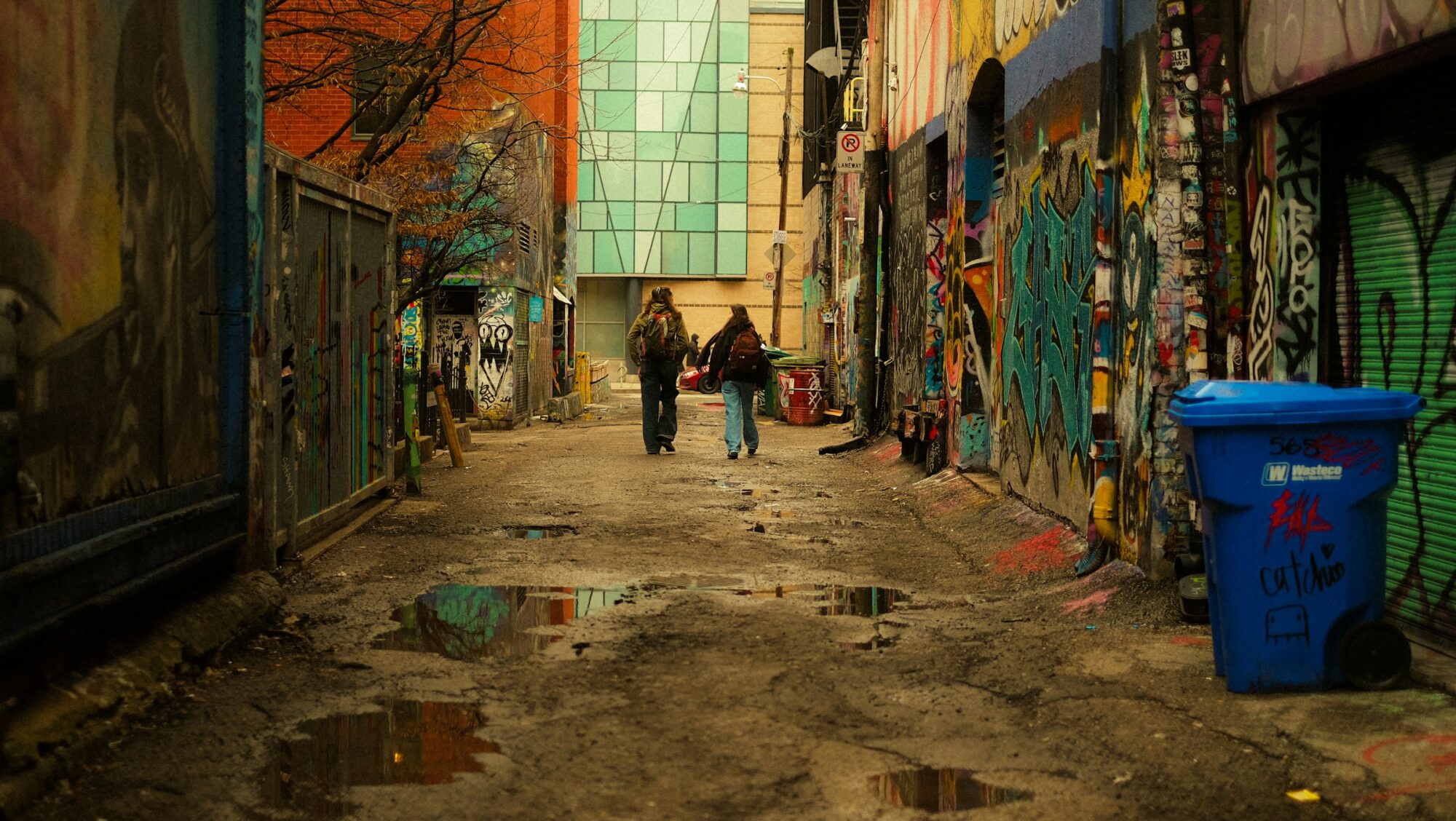
Canadian cities are complicated by a constant attempt to simultaneously meet future demands while correcting the issues caused by past planning and design decisions. What we are left with are “messy cities;” urban areas that are considered iconic and even praised for their development, cleanliness and diversity, withstanding their systemic and structural issues such as housing affordability, traffic congestion, pollution, and social isolation. Despite the “messiness,” cities constantly adapt to change because of the communities that live in them.
Approximately 31 million Canadians, or roughly 76% of Canada’s population, reside in cities and their surrounding regional suburbs. The historical development of most Canadian cities as we know them today, have been “messy,” growing through long periods of economic, social exclusion, and racism. Amid these oppressive periods, subcultures of resistance emerged through art, the reclamation of spaces by community, and the emergence of cultural events and festivals celebrating those communities.
The annual Toronto Caribbean Carnival, previously and commonly known as Caribana, is one such outcome of resistance subculture. This cultural event was developed in the 1970s to support and celebrate the Caribbean community, concurring with the August 1st Emancipation Day, and coinciding with the adoption of the federal government’s 1971 multiculturalism policy. Today, the Toronto Caribbean Carnival is embraced as a major part of the city’s culture, and a result of the messiness of resistance and reclamation by community. Social movements, in their messy contestations that fill public spaces, become landmarks of time and place in cities demonstrating historic struggles like the 1919 Winnipeg General Strike, which is today a part of that city’s celebrated cultural heritage and a notable site of struggle for the rest of Canada to remember.
However, while development through densification and rapid transit infrastructure in cities are planned with the intention of improving economic conditions, equitable development of land remains a point of contention among the diverse communities of Canadian cities. Normally neglected, low-income neighbourhoods are often left out of new urban planning decisions that could pave over the celebrated “messiness” that filled in the gaps for decades. Furthermore, resistance to embracing messy cities can weaken community. For example, noise complaints regarding neighbourhood children playing in parks is a phenomenon that limits public spaces due to a rejection of this aspect of city life.
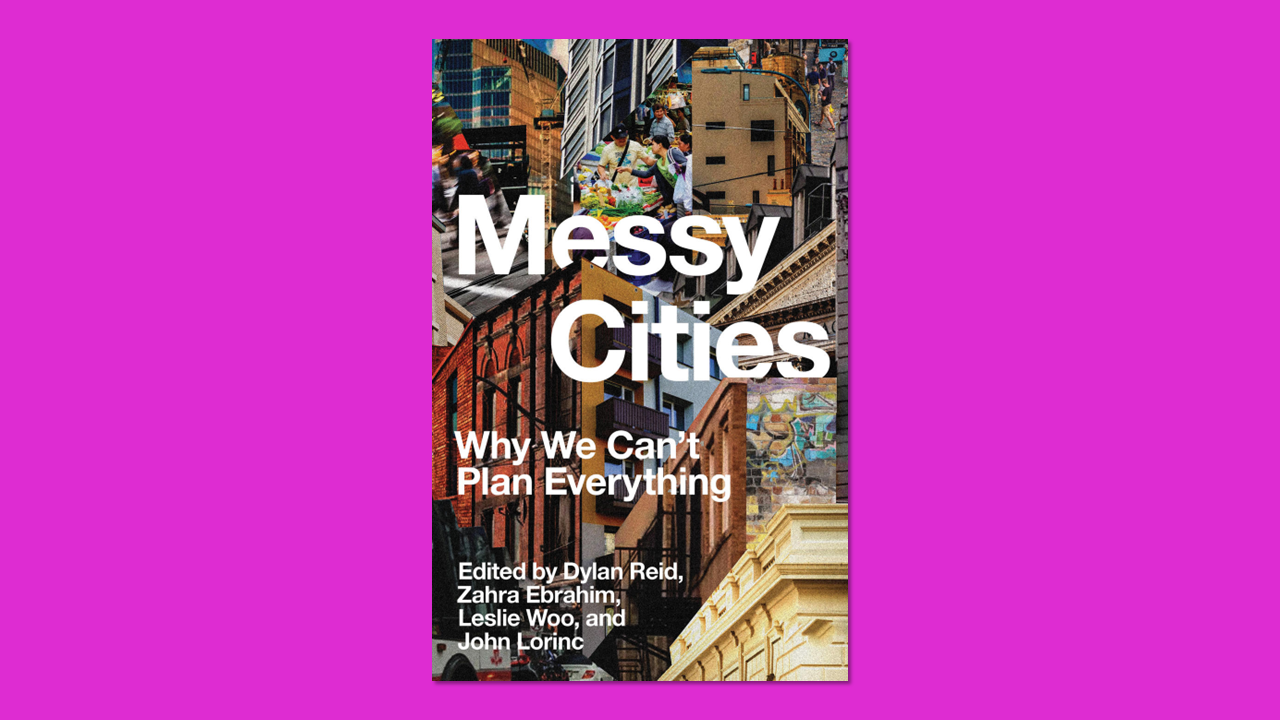
The spaces and movements that form urban cultural, economic, and political life are analyzed in Messy Cities: Why We Can’t Plan Everything; a 2025 volume edited by Dylan Reid, Leslie Woo, John Lorinc and Zahra Ebrahim. Messy Cities highlights the richness and clues in community-led design, and how the scrappiness of cities and urban diversity are what make these areas strong, vibrant, and livable. The collection of essays also explores flawed planning within Canadian cities and around the world, that have inadvertently developed places of connection, inter-dependence and community. For Perspectives Journal, I interviewed co-editor Zahra Ebrahim, CEO and Co-Founder of Monumental, a social purpose business working to advance equitable city-building and development, to talk about Messy Cities.
This interview has been edited for clarity and length.
Brittany Andrew-Amofah: The book is called Messy Cities; but why the term “messy”? How are you reclaiming the word?
Zahra Ebrahim: We talk about the origin of the term in the introduction chapter of the book where one of the contributors to the book mentioned, while visiting Toronto from Los Angeles, “Oh, I just love the city, it’s just so messy.” I also think it’s an interesting question for people who live in Toronto: is the city messy? I think a lot of people feel like Toronto is so overdetermined; that there’s not a lot of space to safely challenge authority and to do it in a way that feels like change is possible. I think the reclamation of the language came from recognizing that our perception of “messy” could only be validated through a diversity of people and voices, as there is no singular reclamation of the word.
In the book, we also talk about “aunties” as a critical voice from diverse urban communities that is normally neglected in the study of cities. Aunties would typically think of this view and ask rhetorically, “why do you want such a mess? We moved here for the opposite of a mess!” There is a generational paradox in the language of messy, which is the case for so many immigrants who came to Canada since the 1970s. Yes, we want expressions of our culture, but do we want a mess? Do we want to live amongst mess? I think that discussion among diverse urban communities remains unresolved, but I also think the whole point is not to redefine it, but to reclaim it; to move messy away from being a negative thing.
Mess has also become a political wedge issue for municipal politics. Some embrace messy while others seek order. But who makes the mess in cities? Primarily, it’s the folks who have a need in the urban environment that is not being met by current systems and institutions that exist. But let’s not pigeonhole the term into being a negative thing. We can create the counter-narrative that it’s immigrants who make the mess and, as a result, bring a heartbeat and story to urban life.
I think Toronto is a Messy City, but not always in a way that is clear to observers. I think some of what we might call “mess,” is what we might call vibrancy on the floors of apartment towers at the neighborhood scale that happen in a way that is unplanned and invisible, but harmonious.
Brittany Andrew-Amofah: With that being said, would you consider Toronto a messy city?
Zahra Ebrahim: Yes, I would. I also think that to embrace the messiness is to also realize that not all mess is visible. One of my favourite contributions to Messy Cities is the chapter by Ajeev Bhatia. I first met Ajeev about 15 years ago in the Kingston-Galloway neighbourhood of Eastern Scarborough when I was working with youth programming for the community. Today, he recalls to me that when he roamed within his own apartment complex, interacting with his neighbours, he would “visit” every country in the world, just by going floor-to-floor. He ate a diversity of food, heard music and different languages, and built community with people.
He experienced a pluralist, multicultural Canada within his own building. From the outside of these Toronto apartment complexes at Lawrence Avenue East and Kingston Road, or at Crescent Town by Victoria Park station, we might not see that diversity. But inside, people are bringing texture to urban life in a messy way that is not always visible. In this diversity, there is community, mutual aid, and common understanding despite cultural differences. I think Toronto is a Messy City, but not always in a way that is clear to observers. I think some of what we might call “mess,” is what we might call vibrancy on the floors of apartment towers at the neighborhood scale that happen in a way that is unplanned and invisible, but harmonious.
Brittany Andrew-Amofah: The book disrupts the city planning space. Why did you decide to co-create it?
Zahra Ebrahim: We wanted to create and add to the narratives about cities, talk more about resident-led change, but also talk about life in cities. When do institutions end and the people begin? A lot of what we talk about in cities is about the infrastructure that helps us meet our needs and actualize the life we aspire or desire. What people call mess is what we [the authors] call the reasons we live in the city.
Why do we have a singular vision for what the city needs amid its own diversity? It’s not a book just about Canadian cities, but I think it’s worth noting that Toronto is an interesting place for experimenting with and embracing disorder.
Brittany Andrew-Amofah: You ended off with saying the infrastructure that helps us meet our needs and actualizes the life that we aspire or desire. Can you just elaborate a little bit more on that?
Zahra Ebrahim: I think the preconceived notions of mess, chaos, or order is very different for the diversity of people who live in Toronto and other Canadian cities. When you are talking to someone from the Global South, urban planning there is very different than here. What this book does is give us an opportunity to redefine what order looks like beyond the Eurocentric paradigm of planning and city building. It helps us to celebrate what some people might call mess, and other people might call the reason we live in a city.
A story that didn’t make it into the book, and one that I often personally reference, is of the “uncle” mango sellers in the Thorncliffe Park neighbourhood in Toronto’s East York borough, who purchase wholesale Alfonso mangoes and sell them in a neighbourhood parking lot during warmer months. This type of mango is culturally relevant to the residents of Thorncliffe Park but are either unavailable in the nearby major grocery store chains or sold at a very high price. Yet, Alfonso mangoes are enjoyed in dishes and everyday fruit by the community who come from South Asian, Southeast Asian, Caribbean, and Latin American origins. This is an instance of an “if-you-know-you-know” moment in a city where unplanned community exchange creates connection to culture in surprising ways; something you can’t look up on Google Maps.
What we’re hoping for with this book is to talk about how mess and order and how that paradox is handled so differently in different places. Why do we have a singular vision for what the city needs amid its own diversity? It’s not a book just about Canadian cities, but I think it’s worth noting that Toronto is an interesting place for experimenting with and embracing disorder. Which is, to my point earlier, not disorder for everyone.
Brittany Andrew-Amofah: The book is divided into 6 sections of 43 essays written by dozens of contributors writing about cities around the world – many of them writing on Canadian cities and their connection to global places. Can you tell me the thought process behind this arrangement?
Zahra Ebrahim: This book grew organically and it wasn’t over thought. We sat down as a group of four co-editors who have very different lived experiences and networks but shared a set of values. We were exceptionally trusting in each other to do at least one of two things: if there was a person who had a story in them that needs to be platformed, I trusted my co-editors to reach out to them and see what story emerges, and I trusted them to name the person who authored the story and bring them to the forefront. The submissions from contributors featured a great diversity of reflections, localities, ecologies, build forms, global cities, and urban systems, and we sat together as co-editors to think about the narrative that tied this all together. Of course, the chapters reflected the biases of the networks of our editorial group, and who we spoke to and invited in, but we were so pleased when we sat down and started to map out what was here. We loved the personal stories.
One of my favorite essays is from the ‘Localities’ section entitled ‘Conjay’s First Walk Home,’ written by Tura Cousins Wilson and Shane Laptiste. It’s a story that imagines Toronto’s Little Jamaica neighbourhood in 2030, and what would happen if today’s advocacy for the community were successful in creating a mixed neighborhood. It was the first time I could envision a community where a future child could walk home in the Little Jamaica neighbourhood and be familiar to smells of food, to the aunties and the shop owners of the community, who could look out to the street where the child was walking and check-in asking, “you okay out there?” It’s not an overthought kind of vision, where we explain complex public policy in terms of transit infrastructure, housing, and urban design—these chapters are created in a very human way of explaining a possibly complex thing by illustrating experiences and a vision for tomorrow.
Brittany Andrew-Amofah: How would you say Toronto has changed from the 1960s until now?
Zahra Ebrahim: We’ve had so many different waves of immigration to Canada since the 1960s, and so much population growth fuelled by immigration. In Toronto, over time we’ve seen a dramatic change to the urban environment. I’ve lived in Toronto for 20 years, and it’s unrecognizable to me in a lot of ways. I think Toronto used to be a place of opportunity, with economic and social mobility. An urban planner could certainly tell you more about the policies that have led to how our cities have evolved and ultimately become less affordable. Unlike the 1960s, Toronto today is no longer holding the promise of, what Canadian journalist Doug Saunders calls, an Arrival City, that attracts newcomers for its social and economic mobility. Toronto has certainly become a more challenging city to thrive in.
The city has become more unaffordable, and the promise of multiculturalism and pluralism has not been fully realized. I worry that the entry-level Toronto, where you can come to Toronto as a young person or a newcomer, is disappearing as city life becomes increasingly out of reach, despite affordability of the city being central to Canada’s multicultural heritage that has developed for over half a century. Many of the communities that built the city are now being displaced and forced to disperse, even while urbanization continues. As the entry-level city disappears, we also risk losing that multicultural identity as the monoculture grows based on the same homogenous class and status that displaces the diversity that has built Canada since the 1960s.
Over the last decade we should have built way more affordable housing on public federal and municipal lands with a nation-wide plan. Even with the 2019 National Housing Strategy, and its focus on low-income communities, we still did not realize more affordable housing. It is now a generational challenge to overcome decades of missed opportunities.
Brittany Andrew-Amofah: What do you think is the biggest city planning mistake currently taking place? And it may not even be a mistake, but considering we’re speaking about messy cities and imperfection, are Canadian cities like Toronto headed in the right direction? What do you think is the biggest opportunity?
Zahra Ebrahim: First, over the last decade we should have built way more affordable housing on public federal and municipal lands with a nation-wide plan. Even with the 2019 National Housing Strategy, and its focus on low-income communities, we still did not realize more affordable housing. It is now a generational challenge to overcome decades of missed opportunities.
However, one of the biggest opportunities we do have is to change that public policy to correct that mistake: building more homes and more infrastructure, and changing policies like zoning restrictions. We can build cities that allow for messiness so that citizens can complete the task of filling them with life, not building them planned and devoid of creativity and dynamism. There is an opportunity to really harness the diverse wisdom we’ve developed from this messiness, to involve in city-building and dislodge ourselves from how we’ve typically done things.
For example, this is an opportunity for more creative models of financing for housing like “Community Land Trusts” that help to remove the price of land from the total cost of building more homes. We need innovative models for funding arts and culture in the city that consider the cost-of-living because cities are losing artists all the time to affordability. I think our challenge is knowing that there are some risks involved in city-building, and that we are going to have to experiment. There are all sorts of interesting experiments that are already taking place in funding and city-building policy models for cultural institutions and housing that exist in other places, but to bring those solutions home to fix past policy mistakes, we must mobilize citizens.
Brittany Andrew-Amofah: In the book, you purposely mentioned that European cities are excluded from this discussion. Could you speak as to why? Also, are European cities the standard? Is that what Canadian cities should be aspiring towards?
Zahra Ebrahim: If you want to read about the development of European cities, there are already many books, debates, and resources to learn more. In the last 30 years many speakers flown into Canada, from Scandinavia and other European countries, to lecture us on urban planning, and I think we’ve got it. They kept their public land and they took opportunities we did not. They are also countries with more restrictive immigration policies and have faced a harder time developing multicultural societies. European cities are not great examples for the Canadian context because they are not super successful in integrating immigrants, and you see harsh, discriminatory policy responses that are incompatible with their own social policies and are not useful examples for Canadian cities and other urban areas elsewhere.
As the development of European cities is already well documented, our editorial group did not feel like the book needed to continue to platform that discussion. Furthermore, we’ve long dismissed the sophistication of other cities, including those in the Global South where the global majority lives, and are, of course, messy. Messy Cities isn’t meant to caricature those places, but instead to learn from those places through experiences and visions that normally don’t come into the urban planning discussion. I think it’s about time Canadians recognize that, in such a diverse, multicultural society, that we can’t just compare ourselves to European cities. We have even set precedent ourselves that others can learn from, with some of the most multicultural cities in the world.
To build Messy Cities, we must continue to reinvest at that scale. Our social fabric is the most important infrastructure we need to repair and build.
Brittany Andrew-Amofah: What is the top takeaway for readers? What do you want them to walk away with, in terms of their understanding of cities like Toronto, but also how to act for positive change?
Zahra Ebrahim: What we want people to walk away with is that the city belongs to you, and that’s part of why we ended the book with my essay entitled ‘Confessions of a First-Time Parade. In this chapter, I recount an hour-long, haphazardly designed community gathering that reminded my neighbours that we have a place to come together and experience joy. The spontaneous parade that we organized was a contested space, but among neighbours we were not contesting each other. David Suzuki calls these local communities “units of survival,” and urges these gatherings to come together to defend our neighbourhoods against social, economic, and climate shocks. To build Messy Cities, we must continue to reinvest at that scale. Our social fabric is the most important infrastructure we need to repair and build.
Brittany Andrew-Amofah: Lastly, what do you think has been the leading cause of the weakness of our social fabric?
Zahra Ebrahim: I think polarization all over the world has weakened our social fabric, even among our own local neighbourhoods. I also think the COVID-19 lockdowns shaped a generation’s social patterns and how they perceive community building. I also think that economic conditions have developed monocultures in our neighborhoods as we are separated by material class and income difference, which further differences based on identity. When you don’t see your neighbours, when you’re not confronted with differences on the regular in public spaces, whether it is in our neighborhoods, on the subway, walking downtown, when we are not regularly in negotiation with each other because there is no engagement with each other, we risk weakening the social fabric. We need the city to nudge us into messiness and into confronting difference, or we will choose comfort and sameness, and we will not grow.