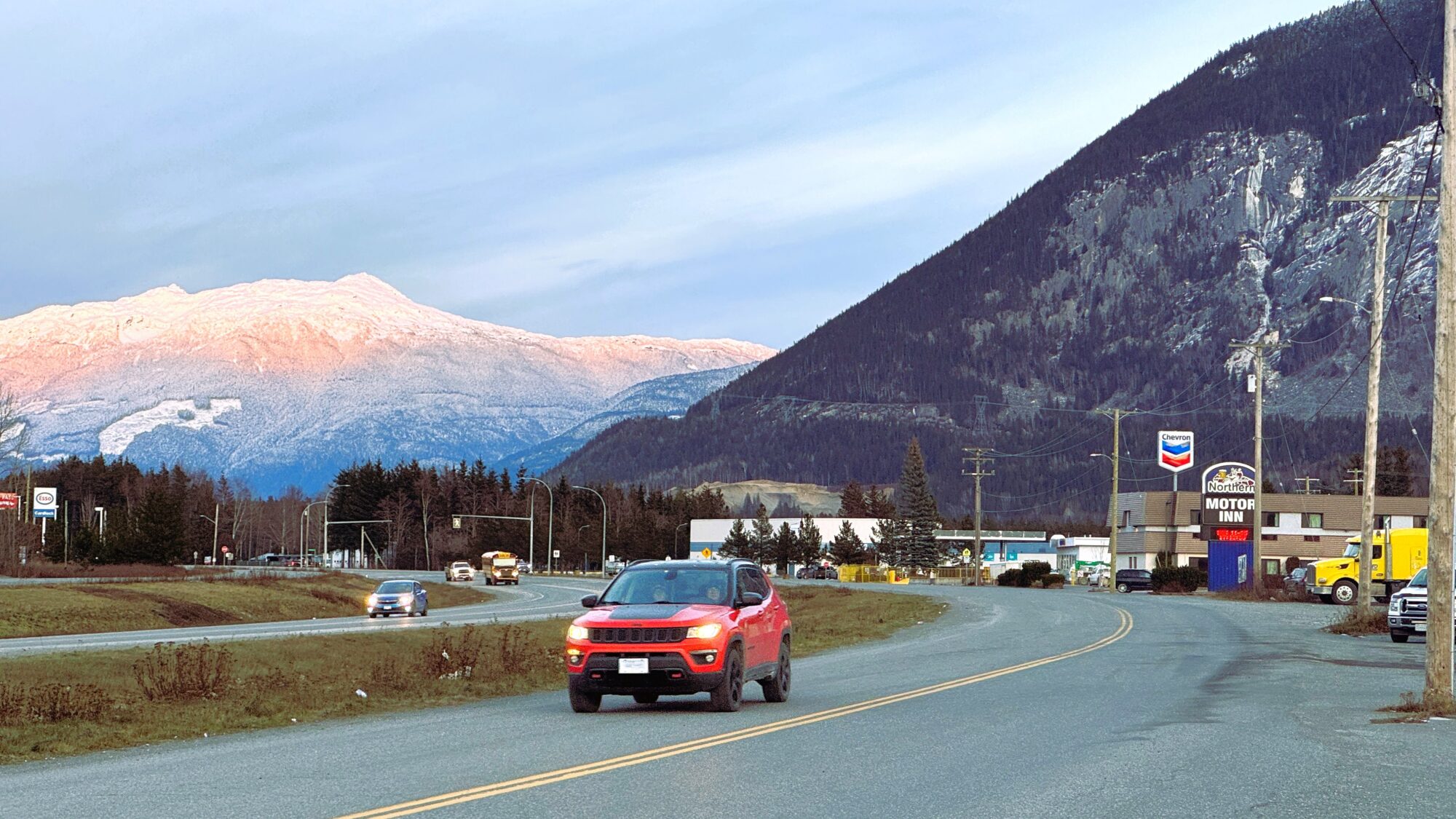
On August 27th, 2025, about 50 activists gathered at City Hall in Terrace, British Columbia, a rural community of 12,000. From City Hall, they marched to Skeena—Bulkley Valley MP Ellis Ross’ constituency office where they delivered a letter demanding an arms embargo against Israel. The protestors marched from there to a nearby park, where they gathered to hear community members speak about the horrors of Israel’s genocide in Palestine, Canada’s involvement in these crimes, and how ordinary Canadians can build power and fight to win a different world.
Terrace, like most of rural Canada, is not a place where many political marches happen, and when demonstrations do happen, they are generally not for left-wing or internationalist causes. The last notable political rally in Terrace was a “freedom convoy” that rolled through town in support of the 2022 occupation in Ottawa. Which is what makes the August 27th rally, and, more broadly, the wave of Palestine solidarity organizing that has seized rural Canada since late 2023, so unusual. From Terrace to Yellowknife, Northwest Territories to Bridgewater, Nova Scotia, Canadians have organized themselves in solidarity with Palestine, mobilizing rallies, developing educational programs, and launching letter-writing campaigns.
Despite this groundswell, the Palestine solidarity movement has so far failed to achieve its goals: the genocide continues, Canada continues to arm Israel, and Canadian troops are complicit in ceasefire violations. This begs the question: how can the movement turn this uniquely broad and deep organizing network that has emerged organically over the last two and a half years into real political change? How can it be used to end Canadian support for US and Israeli violence?
Part of the difficulty of this question lies in the increasing disconnect between Canadian public opinion and Canadian political parties on the question of Palestine.
Prior to 2023, Canadian public opinion indicated majority support for Israel, broadly in alignment with Canadian policy. By May 2024, the balance had flipped: more Canadians sympathized with Palestine than with Israel. In the ensuing two years support for Israel has dramatically fallen and, today, more than half of Canadians view Israel as committing genocide.
Despite this complete and total reversal, Canada’s Conservative and Liberal parties remain broadly united in their commitment to the US and Israeli genocide in Palestine and the countries’ wars across West Asia. With the new Liberal majority, there won’t be an election for three more years, and even if there were, there are few levers available for applying democratic pressure against either on the issue. The NDP, with its new outspoken leader, Avi Lewis, is a third pole, but it is more electorally impotent than ever. The prospect of forcing a shift in policy through federal electoralism, in other words, is bleak, at least for the time being.
Given that, how can the Palestine solidarity movement achieve concrete political wins in Canada? These grassroots organizers could contest more democratic terrain, instead: municipal elections.
Municipal elections are largely independent of the federal and provincial party infrastructures that enable establishment powers to filter out pro-Palestine positions. They also tend to be profoundly winnable, particularly in rural communities where elections are often won with hundreds of votes. It is almost unheard of to have the kind of organizing teams that have developed around Palestine solidarity working on municipal elections in small communities, particularly outside the narrow window of the election.
Winning municipal-level elections could serve two purposes for the Palestine solidarity movement in Canada. First, it would send a clear electoral message to the dominant federal parties that Canadians will continue fighting against the government’s support for genocide; that the solidarity movement is increasingly well organized; and that Canadians are willing to vote for candidates who campaign on this at any scale. Second, it would lay the groundwork for a wave of municipal-level Apartheid-Free Communities (AFC) pledges, commitments to advocate against apartheid in Israel and to implement boycott, divestment, and sanctions (BDS) policies.
AFC is a coalition convened in 2022 by the American Friends Service Committee, a Quaker-founded organization that campaigns for global justice, including against South African Apartheid in the 1960s and 70s. As of April 2026, eight municipalities in Canada have passed AFC motions. These motions are both symbolic and material, committing communities to advocate with higher levels of government, to implement BDS policies (to varying degrees), and to conduct political education. Today, organizers are fighting to win AFC pledges from rural and urban municipalities across Canada. The municipal elections offer an opportunity for that fight: movement candidates could effectively put AFC measures on the ballot.
Elections themselves are opportunities for political education, for expanding organizing communities, and for securing media coverage—something the Palestine solidarity movement has largely been shut out of. Electoral candidates get media coverage by default. Imagine if every community in Canada had a municipal candidate who used their interviews, their town halls, their public appearances, to speak about out the genocide and ethnic cleansings underway in Gaza, the West Bank, and, increasingly, Lebanon. As well, Canada’s support for an illegal US-Israel war on Iran can’t be understood outside the context of the genocide in Palestine.
These voices have been systematically excluded from public discourse. Municipal elections are an opportunity to force them onto centre stage and, in so doing, to confront the role Canada is playing in shaping a terrifying new world order.
The Palestine solidarity movement has built a vast, largely self-organized network across Canada, including in rural, often conservative communities. It is one of the most organized and geographically diverse political movements in recent memory. Ending Canada’s support for US and Israeli wars in West Asia should be a top priority for anyone concerned with global justice or a livable future. The Palestine solidarity movement and the left more broadly should leverage this unique organizing momentum to contest the municipal terrain as part of a project of building a bottom-up, left-wing, and internationalist resurgence.