In the weeks following the assassination of US far-right online influencer Charlie Kirk at Utah Valley University in September 2025, many right-wing influencers lined up to inherit his following. Canada has not been immune to Kirk’s celebrity and influence, with Canadian right-wing influencers copying his template.
Before becoming elected as a Conservative MP in a 2024 byelection, Jamil Jivani, a friend of US Vice President J.D. Vance, rose to prominence in the last several years as an outspoken right-wing activist who echoes US far-right influencers at a Canadian audience. Once admired by mainstream conservatives early on in his career, Jivani was appointed by Ontario Premier Doug Ford as the province’s “Advocate for Community Opportunities” in 2019. Jivani resigned this post in 2022 after announcing his disapproval of the Ford government’s COVID measures, closing schools and using so-called “vaccine passports” for public areas.
Immediately after Kirk’s assassination, Jivani launched ‘Restore the North,’ a new university campus event series described as, “part rally, part recruitment drive, and part debate,” and modeled after Kirk’s own Turning Point USA organization, aiming to bring the “same type of energetic and enthusiastic conversations up here.” Jivani’s events have explicitly targeted its appeal to young men who “cannot be forgotten” and their feelings of disenfranchisement, with a policy platform that includes a call to “free the Zyn” – a popular brand of oral nicotine pouch among young men that is not authorized for sale in Canada by Health Canada authorities. This rather “memeable” plank appealing to liberties is stated alongside other right-wing calls to “seize the drugs” and “fix immigration” which also finds common cause with the far-right in Canada. As a result, the Restore the North campaign’s appeal to young men through more populist policy has also attracted the attention of extremist political movements.
Jivani’s ‘Restore the North’ tour, with ties to his MP office, are not ‘partisan’ events; open to all who may not be card-carrying members of the Conservative Party of Canada. At these events, students speak about their suffering under successive austerity measures, disenfranchisement, the consequences of speculative and financialized necessities (e.g., housing), limited access to reliable care, and their general contempt for their class position. Jivani’s response catalyzes these fears, but does not put the blame squarely on the rich and powerful responsible for these problems.
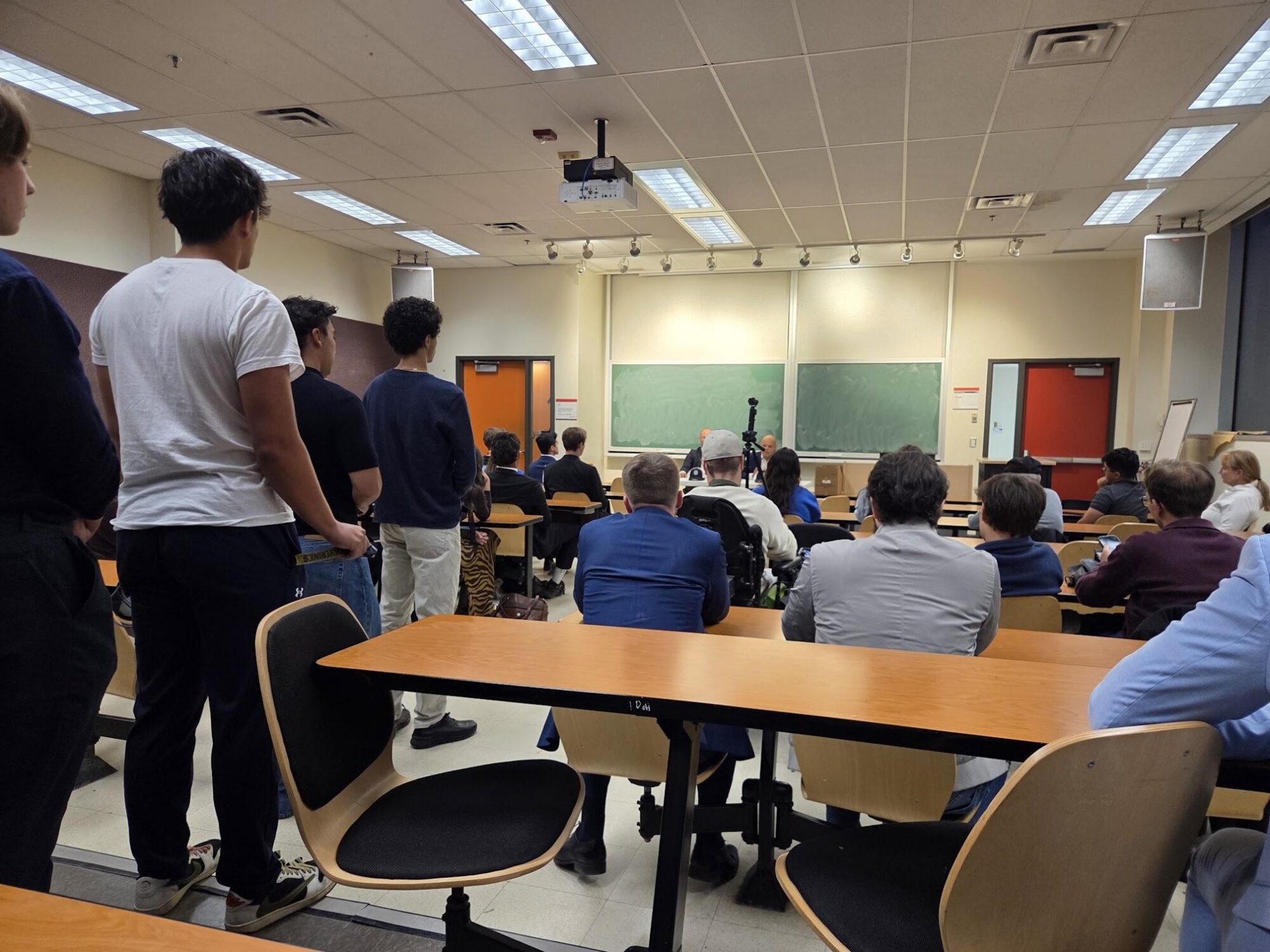
Attending Restore the North’s Carleton University stop on September 24, 2026, I heard Jivani warn of a (allegedly impending) Liberal government plot to grow Canada’s population to 100 million through immigration. He claimed that the current Liberal government was working towards changing the demographics of ‘our’ neighbourhoods such that our parents, and their parent’s parents can no longer recognize ‘their’ community. Immigrants were also blamed for ‘overcrowding’ the healthcare system, ignoring cuts and staffing shortages imposed by provincial governments and federal health spending that has not kept up, to the extent that medical assistance in dying has become a viable alternative to insufficient care. He blamed temporary foreign workers for high youth unemployment, DEI for eroding Christian values, and diversity for weak patriotism, despite its renewal in the face of US President Donald Trump’s trade war. Immigration and diversity are blamed for siphoning resources away from the ‘real’ Canadians.
The Carleton University crowd listening to Jivani was mostly made up of young, white men, who asked questions at a public microphone in the same style as Kirk’s TPUSA ‘Prove Me Wrong’ campus debate events. Of all the statements made or questions asked at the public microphone, the majority discussed immigration.1 Three of the young men at the microphone passionately advocated for policies of remigration in Canada: an ideologically far-right position that calls for the forcible expulsion of non-white immigrants.2 Pushing Jivani on his views on immigration and the merits of multiculturalism in Canada, these young men at the microphone argued that immigration to Canada has been a “disaster” that has led to changing demographics and the loss of a ‘Canadian’ identity. After citing their hopes to “conserve the nation,” a sentiment that received a round of applause, Jivani was forced to reckon with the logical endpoint of his own sentiments towards immigration.
Participants cited that Jivani talked “a lot about immigration” and its shortcomings, but these men found Jivani’s answers insufficient. One participant encouraged Restore the North attendees to check out other groups such as Second Sons, known for Residential School denial, and the Dominion Society, a white nationalist group, if they “thought the same as [him].” These criticisms and invitations went unchallenged in the room.
For Canadian progressives, the rhetoric and far-right enablement coming from Restore the North events on Canadian university campuses should be of deep concern. Eliminating scapegoats are being sold as the solution to unemployment, housing, and the cost of living – at great danger to Canada’s social fabric. To fight back, we need more progressive voices on university campuses that can speak to democratic empowerment and the billionaires who are to blame for systemic problems. If progressives do not take these campus tours seriously, it is the far-right who will seize the opportunity.
Notes
- In total, during the Q&A period, students posed 18 questions/statements and 11 were directed toward immigration. ↩︎
- Also, see Rachel Gilmore’s explanation of ‘remigration’ as it relates to the Dominion Society. ↩︎