Only months into Avi Lewis’ leadership of the New Democratic Party of Canada, the work to rebuild the party appears underway. Beyond “winning seats” in a long forthcoming federal general election, “rebuilding” the NDP from the disastrous 2025 election results involves three main tasks: restoring energy among current members, growing the membership, and regaining public support. These three tasks will depend on making the party more internally democratic. This is clearly recognized by Lewis who has the stated ambition of making the NDP “a political instrument of the people” which entitled his leadership policy platform for renewing party democracy. However, this goal cannot be achieved by reproducing the 20th century model of intra-party democracy that still structures the party. Instead, building a truly democratic party requires a new model for the 21st century, capable of raising the bar for Canadian democracy. There are certainly proven alternative models that have worked and have been previously demonstrated within the NDP.
Why Democratize?
Democratization is necessary to building momentum and reenergizing the existing party from its current inertia. Greater internal democracy would address long-standing discontent among NDP members of disempowerment within the party – a democratic deficit found in nearly all of Canada’s political parties. After the NDP’s catastrophic result from the 2025 federal election, membership empowerment became a key promise during the party leadership race that followed. All 2026 leadership candidates proposed changes to party practice and structure to re-energize the membership, demoralized after the collapse, though Avi Lewis’ proposals could be seen as the most ambitious among them. Given the leadership race’s record number of votes and turnout, despite the 2025 election result, NDP members have yet to walk away from substantive party reform.
Table 1 – NDP Leadership Election Votes and Turnout
| NDP Leadership Election | Total Membership | Votes Cast | Turnout |
|---|---|---|---|
| 2026 | 100,542 | 70,934 | 71% |
| 2017 | 124,587 | 65,782 | 53% |
| 2012 | 127,914 | 65,108 | 51% |
However, today’s party membership only accounts for 8% of those who voted for the NDP in the 2025 federal election. While other parties can afford to treat membership as a fan club, for a party aspiring to be “a political instrument of the people” this proportion of membership to electorate is comparable to the Conservative Party’s and the Liberal Party’s membership levels and general election votes. Internal democratization is essential to growing the membership by making it easier to both recruit and retain members. It is typically a challenge to recruit engaged citizens to political party membership beyond campaign volunteer work in demonstrating the value of active membership. New forms of party participation and democratic empowerment would make recruitment easier by demonstrating membership as a path to democratic power across wider Canadian society. Empowering members through plebiscites and other democratic decision-making opportunities within the party demonstrably help to maintain membership, giving members meaningful value and motivation to remain active within the NDP. Democratization can contribute to rebuilding the NDP’s public support by clearly differentiating it from the other parties. An internally democratic NDP demonstrates its commitment to wider democracy, encouraging Canadians to join and support the only party that aims to empower citizens.
Most people join a political party due to their commitments to that party’s values, policies, and leadership. Party supporters also become members to take part in decision-making that shapes society. However, most Canadians, especially young people, are deeply dissatisfied with parties because they feel they have no real power or influence on their decisions and leadership, even as members. This sentiment is reflected across Canada’s political parties: while membership rolls may swell during leadership races as candidates recruit new members to become eligible to vote for their candidacy, these membership levels typically crash soon. For “losers” of intra-party democratic processes, there is little left to do after the initial recruitment to participate in party elections and engagement wanes. Commitment to values, policies, and leadership is not enough: democratic empowerment is necessary to maintain a political movement that depends on democratic engagement, rather than the direction of capital.
The Old Model of Intra-Party Democracy: Conventions
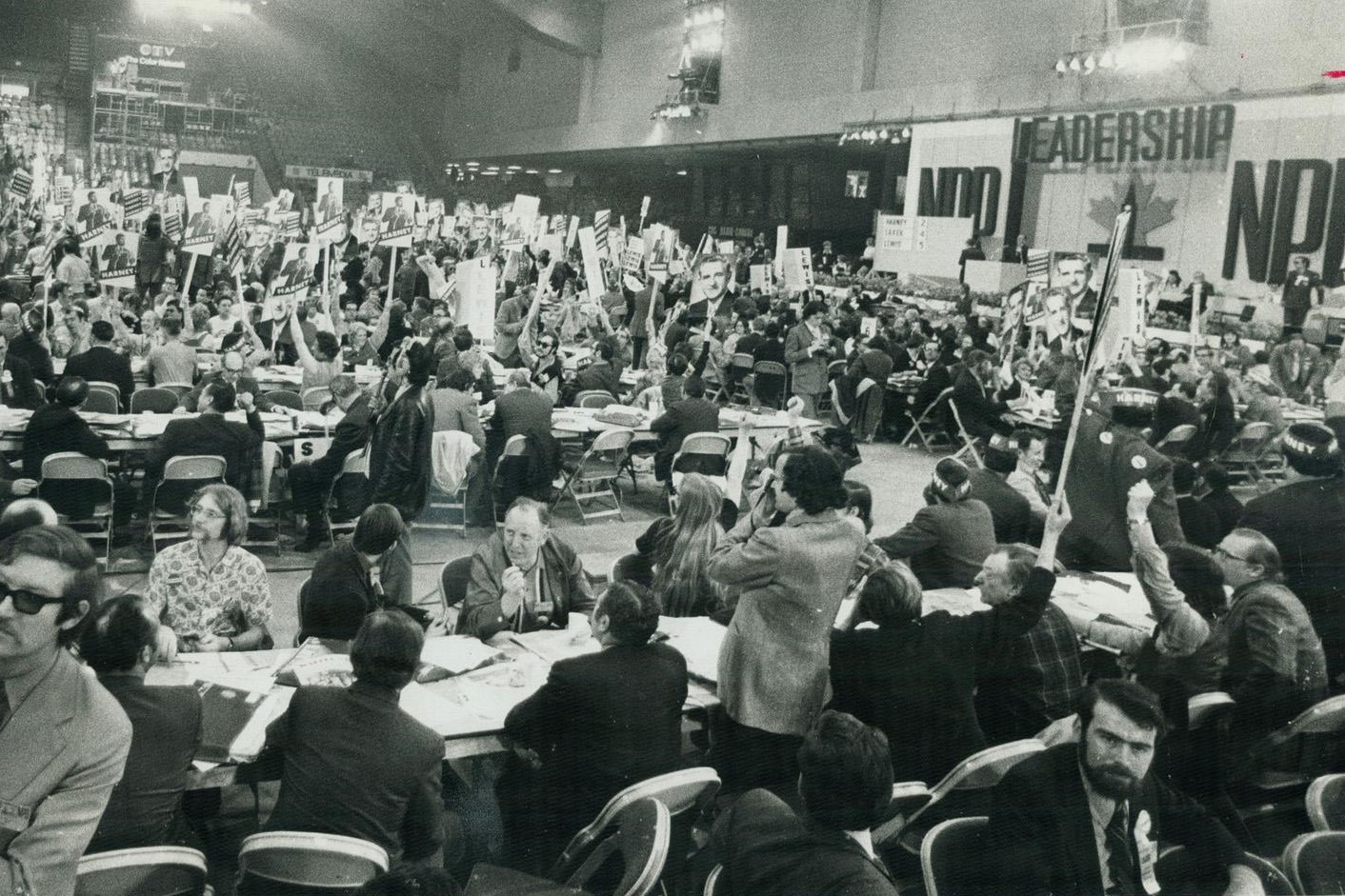
Lewis’ 2026 leadership campaign platform contained ideas to reinvigorate party democracy such as ongoing policy development in consultation with the membership and increased transparency. Most of all, the campaign platform proposed tweaks to an outdated model of intra-party democracy that has long been ill-suited to today’s politics. Today, outside of leadership elections, Canada’s political parties operate on a delegated model where members participate in policy decision-making via electoral district associations (EDAs) and bi-annual conventions. Delegates to party conventions are elected by EDAs to debate at convention, vote on resolutions, and elect officers. Between conventions, most of the party’s decisions are made by the leader, elected caucus members, and officers.
This model emerged after the Liberal Party of Canada’s first national convention in 1893 under the leadership of Wilfred Laurier, but national Liberal and Conservative Parties only adopted regular policy conventions in the 1950s. Canada’s first experience with true intra-party democracy came from the wave of populist, progressive, and socialist parties that began in the early 20th century, up until the post-war era such as the United Farmers of Alberta, the Progressive Party, the Social Credit Party, and the Co-operative Commonwealth Federation. Outside of Canada’s national electoral duopoly, these political parties aimed to facilitate mass participation via strong local chapters and regular conventions.
A century ago, these represented a major leap forward for democracy in Canada. Nevertheless, this model is no longer adequate for the expectations, possibilities, and demands of 21st century politics, especially for the NDP in its declared ambitions towards greater party democratization. There are three major democratic shortcomings in the way intra-party democracy is conducted by Canadian political parties, and by the NDP, through convention cycles.
First, the current cycle of conventions among political parties relies on delegation, meaning most party members elect a delegate to attend convention and participate in decision-making on their behalf. This was once necessary to enable mass participation at national scale, but political parties in Canada have gradually shifted towards more direct forms of leadership selection. The leader was originally chosen by caucus, then elected by delegates at convention, until parties began to adopt “one member, one vote” systems. The NDP has held this leadership selection system since the 2003 leadership race that decided Jack Layton as NDP leader in a mixed system that weighted labour delegate votes, moving to a fully one member, one vote system for the 2012 leadership convention.
The national Conservative and Liberal parties also provide votes to all members in leadership elections, but these systems today are weighted by the distribution of electoral districts and other considerations. This trend has continued, albeit much more slowly, for policy decisions among political parties. Policy, for all parties, is still strongly influenced by the decisions of the party leader, caucus, and staff, who may also set the priorities for debate at delegated policy conventions. Since policymaking is one of a political party’s most consequential activities, advancing real internal democracy requires devolving this power to the membership.
Secondly, biannual policy conventions were once limited by the speed of travel and available communications technologies, yet this was sufficient for the pace of politics of the 20th century. The mass parties’ use of bi-annual conventions was distinct from the irregular and ad hoc convention model of the mainstream parties (the Liberal Party held three conventions between 1893 and 1948). During this early period, mass party members could influence their party’s consequential decisions, even if only a small fraction participated directly as delegates. Today, technology can facilitate wider participation, far more often. The pace of politics in today’s world requires constant democratic input if membership is to retain control, rather than forfeit decisions to executive control by leader, staff, and caucus.
Holding policy conventions annually, as Lewis’ leadership campaign suggested, would be an improvement but would still be woefully insufficient to ensure members control the party’s direction when this can shift on a monthly or even weekly basis. At best, power within the NDP today is left to officers such as the party president, vice presidents, and treasurer, elected by convention delegates – this power is delegated by party members to EDA delegates who then elect the party officers. This indirect control lends to the feelings of disempowerment among members, who values and participation have previously been neglected between this chain of collective decision making.
Third, while conventions give members some access to power through engagement with the party institution and its leadership, they are largely inaccessible to most Canadians. Delegated convention participation is restricted to a very small proportion of party membership; itself, a small proportion of the party’s electorate. Convention participation is only accessible to those who can afford cross-country travel as well as time away from work, family, or school. Even if conventions could be hosted online in a hybrid format, as Lewis proposed, it is still challenging for members to take the time and energy to participate. The high intensity of an event like a national party policy convention can also be barrier for new members, who need more approachable ways to start their participation and maintain their engagement. which are nonetheless sufficiently impactful to keep them motivated.
Reforming Electoral District Associations
EDAs were once real engines of membership empowerment for the NDP, yet there are several issues that make them unsuitable for member participation in the party’s internal decision-making today. First, the NDP’s highly dispersed base of support means many current and potential members live in areas without the critical mass to sustain active EDAs. Thus, when EDAs are the main entry-point to the party, many would-be members do not have access to active EDAs for participating in decision-making. Party members are left on the sidelines while most activity occurs in large EDAs in a few urban areas and historical NDP strongholds. This results in a membership that is smaller and more disproportionately urban than it otherwise could be.
Second, EDAs are ill-suited to facilitating deliberations on the national issues that define today’s politics. Most people are motivated to join a party by national or provincial issues, so if EDAs focus on local issues, they struggle to attract and retain members. But if EDAs focus on national issues, they pointlessly silo members into parallel discussions on the same issues, making deliberations less active (thus less engaging) and less regionally diverse (thus more parochial) than could be achieved by national deliberations among the whole membership.
Third, relying on EDAs as the main sites for member deliberations means New Democrats only speak across provincial boundaries at bi-annual conventions—and most members do not get the chance to engage in these venues. This prevents the spread of ideas and the cultivation of mutual understanding and inter-regional solidarity which might stem from frequent, nation-wide, all-member deliberations. The federal leader would not need to delicately manage tensions between provincial leaders if membersin all provinces could regularly speak with each other and develop the sense of being a truly national movement. This would especially help NDP members from the rest of Canada better understand Québec and Alberta; provinces where federalist dialogue is needed.
The old model of intra-party democracy is clearly insufficient for democratizing the NDP and presents more challenges for rebuilding the federal party after its 2025 collapse. Conventions are no longer suited to the expectations, technology, culture, and schedules of today, and EDAs leave the membership smaller, more isolated, less diverse, and more divided than it could be. Turning the NDP into “a political instrument of the people” will require a new model built on forms of participation that are more direct, more frequent, more accessible, and less demanding. It will also require new venues for nation-wide, all-member deliberation, which must inevitably be built and facilitated by the central party. Fortunately, new tools to facilitate mass engagement already exist and have proven to work within the NDP.
A New Model: E-Democracy
Over the last decade, the rapid growth of ‘e-democracy’ has meant the expanded use of digital tools for large-scale deliberation and participatory decision-making. Among the most popular of these is Polis, an open-source tool for deliberations with the potential to include millions of participants. Polis is a digital tool that engages users with voting and short commentary, while an algorithm continuously identifies ‘opinion groups’ and prioritizes comments that unify them. This lets participants gradually and cooperatively work towards consensus, with ideas rising or falling based on quality (not quantity) as judged by the collective (not moderators) and cross-group agreement (not simple-majority support), which also tends to create a bias for positivity (not outrage).
In addition to many large-scale uses around the world, Polis has already been used within the NDP. It was first used at the 2023 federal convention among delegates to discuss priorities and the party platform in parallel with in-person debates over resolutions. While the webpage was only available to delegates during the Hamilton convention, there are more possibilities if were open to all members who could not participate in the in-person event. At the time, MP Matthew Green used Polis in 2024 to consult the public on sponsoring and drafting the so-called “Nakba Bill” to submit as a private member’s bill, acknowledging the historic catastrophe and its continued impact on the Palestinian people. While the results were merely consultative and the PMB failed to pass as Parliament dissolved before the end of the process, the tool demonstrated the potential to bring forward public policy deliberations to caucus and let ordinary Canadians take responsibility for drafting legislation. Most recently, the NDP Renewal project used Polis to host discussions on how to rebuild the party. While the results were used to draft convention resolutions, they could have been made directly binding on leadership.
Polis also presents an alternative mode of online engagement. Instead of email fundraising and signature drives, members could be periodically invited to deliberate on current issues and inform the party’s public stance or even its Parliamentary activity. Engagement could become accessible to membership with little time or money to commit to participation. Polis helps to determine priorities, allowing users lower barriers to engagement. Instead of waiting years for a convention, or months for an EDA meeting that may be scheduled for an inaccessible time, members could incrementally contribute to a continuous policy-making process from their commutes or their breakrooms.
Another popular tool is Decidim: an open-source toolkit used for e-democracy platforms globally and found in participator process in Barcelona, Helsinki, the EU, Brazil, and New York City. Canadian jurisdictions such as the Government of Québec, and cities such as Montréal, Vancouver, and Ottawa use similar toolkits. Decidim-based platforms have been used for participatory budgeting, co-design of technical services, and continent-spanning debates on issues like immigration and climate policy. Several political parties have used similar platforms for member participation, including Spain’s Podemos, Italy’s 5 Star Movement, and Canada’s Green Party.
The NDP could use a tool like Decidim to reach a level of regional, provincial, and federal cooperation far beyond the inter-EDA networks and enhanced use of Mobilize, an NDP digital platform used to coordinate campaigns, manage databases, and organize outreach, proposed by Lewis’ leadership campaign platform. Centralizing information for members on their EDA’s activities would help to reinvigorate activity and facilitate regional cooperation. The national-level platform could host internal decision-making processes, allowing members to find in-person events, connect with local members, keep up with Parliamentary legislation, track the work of member-elected officers, vote on member-initiated proposals, and participate in all-member deliberations.
Eventually, an internal e-democracy platform could be used for members to collectively decide how the caucus would vote in Parliament, or even for ordinary members to initiate, debate, select, and design legislation that would be tabled in Parliament by NDP MPs on behalf of all New Democrats.
Conclusion
Real intra-party democratization is the only path to rebuilding the NDP by re-energizing current members, recruiting and retaining new members, and rebuilding our public support. By reinvigorating party democracy, the NDP can demonstrably make the pitch that other political parties promise to govern you well; only the NDP promises to help you govern. This is clearly Lewis’ goal, but realizing that goal will require a far more ambitious plan than rebuilding the CCF’s century-old model of intra-party democracy. Reviving the NDP’s legacy as a mass party requires new innovation for today’s world to recover the purpose that motivated democratization—to grant ordinary citizens the maximum possible role in the governance of Canadian society.