The League for Social Reconstruction was the product of a British idea and a hike in the United States. In 1931, amid the Great Depression and atop the 1000-metre-tall Mt. Greylock, the highest point in Massachusetts, Frank Scott and Frank Underhill discussed a plan that would help to bring socialist ideas to Canada. Underhill, a committee democratic socialist, essayist, and historian, “stressed the need for a sort of Fabian society in Canada”1 to his colleague Scott. Underhill believed that with the increased organization of labour and farmer movements, a new left-wing political party in Canada would soon emerge. And like the Fabian Society, a British extra-parliamentary organization meant to cultivate and disseminate socialist ideas, and the rise of the UK Labour Party in Parliament in the early 20th century, Underhill saw an opportunity. There should be, he believed, a mass organization of intellectuals in Canada that could provide a new Canadian socialist party with the coherent intellectual and ideological legitimacy, and the policy platform to advocate for. Scott and Underhill would conclude their hike with a new mission to build this new organization; the League for Social Reconstruction would be developed as socialist think tank and act as a force for Canadian public policy.
Building the League for Social Reconstruction
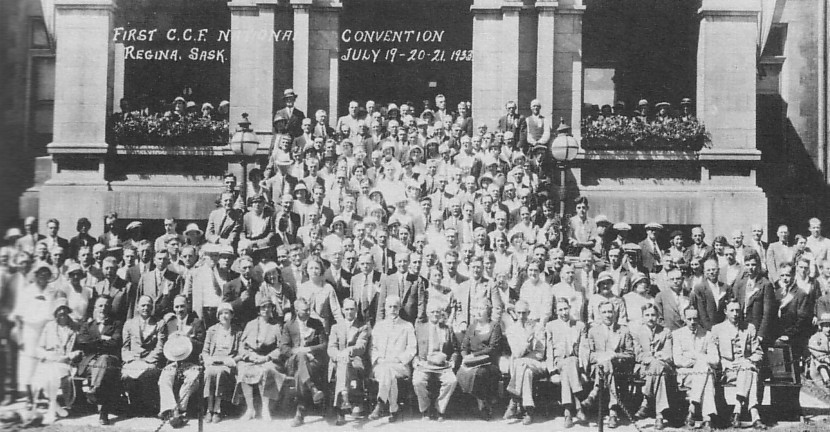
Formally founded in 1932,2 the LSR would quickly assert its leading ideological and intellectual role in shaping the new democratic socialist electoral left organizing in Canada. The Manifesto of the League for Social Reconstruction calling for a social order for the common good rather than private profit. At the invitation of the newly formed Co-operative Commonwealth Federation’s national council, the LSR was tasked with crafting an official manifesto for the nascent party.3 Based on the existing LSR manifesto, Underhill and other contributors over the summer of 1933 drafted what would become the Regina Manifesto which was approved by CCF MPs, including CCF leader and LSR member J.S. Woodsworth. Upon its adoption at the inaugural 1933 founding convention of the CCF, Woodsworth stated, “[I] can only hope that the convention will adopt this carefully thought-out statement rather than attempting to throw in a lot of half-baked suggestions.”4
In writing the Regina Manifesto, the LSR had made an early impact on the CCF and a lasting impact on the rhetoric and semiotics of the Canadian left.
The Regina Manifesto draft did include some significant changes from the earlier LSR Manifesto draft. The Regina Manifesto spoke to agriculture, which took up a significant chunk of the newly drafted manifesto, in addition to a section on civil liberties.5 Most influentially, and absent from earlier drafts, was the concluding statement of the Regina Manifesto that, “No CCF government will rest content until it has eradicated capitalism and put into operation the full program of socialized planning which will lead to the establishment in Canada of a Co-operative Commonwealth.”6 Added to the Manifesto at the founding 1933 Convention, this statement lent an air of radicalism that, at least on close reading, is not entirely present in the finished manifesto.
In writing the Regina Manifesto, the LSR had made an early impact on the CCF and a lasting impact on the rhetoric and semiotics of the Canadian left. This would be far from their only contribution. Published in 1935, Social Planning for Canada was an influential edited volume put together by a committee of LSR members to provide an analysis of the capitalist system in Canada, and to define the end goal toward which political action should be directed. It was the first comprehensive democratic socialist book published in Canada, with contributions by dozens of authors, credited and uncredited. Social Planning for Canada was an early success, selling out of its first run immediately upon publication, and continuing in popularity among activists, students and CCF organizers until the Second World War. It functioned as a foundational text for Canadian socialist thought, but also as a tool of movement-building.
By the late 1930s, the LSR had firmly established its dual role as both a think tank for the CCF and a broader hub of socialist intellectual life in Canada. Through its publications, personal networks, and institutional connections, the League helped to define the language, assumptions, and strategic horizons of English-Canadian democratic socialism during its formative period. Closely intertwined with the history and influence of the League for Social Reconstruction was its relationship with Canadian Forum, one of the most influential intellectual journals in 20th century Canada. Founded in 1920 in the aftermath of the First World War, Canadian Forum initially emerged as a progressive, nationalist, and reform-oriented publication, concerned with questions of culture, politics, and Canada’s place within the British Empire. While not originally a socialist journal, it provided an institutional and discursive space that would later prove crucial for the development of democratic socialist thought in Canada.
By the early 1930s, as the crisis of the Great Depression deepened and the LSR began to cohere as an intellectual network, Canadian Forum increasingly became an outlet for League members and fellow travellers. Key figures of the LSR were directly involved in the journal, shaping its tone and priorities. Through essays, commentary, and debate, the journal functioned as an outlet for articulating and refining the ideas that would underpin both the LSR’s programmatic work and the broader ideological direction of the CCF. In 1935, the LSR purchased the Canadian Forum, using the proceeds from a fundraising drive and the profits from the sales of Social Planning for Canada, establishing the Forum as the home for left-wing thinking and writing in Canada.7
The Canadian Forum allowed for a more experimental and discursive engagement with socialist ideas. Contributors debated the merits of planning, the role of the state, civil liberties, and the cultural dimensions of social reconstruction. This made the journal particularly important as a site of intellectual development, where ideas could be tested, contested, and popularized before translation into political platforms. The relationship between the LSR and Canadian Forum also illustrates the League’s broader strategy: rather than merely writing policy for the party to use, or to generate better policy solutions, it sought to shape the terms of debate within Canadian public life through mass media. Through the magazine, LSR-affiliated thinkers were able to intervene in ongoing discussions about economics, governance, and national identity, gradually normalizing ideas that were considered outside of the status quo.
The League for Social Reconstruction’s influence persisted through the institutions and intellectual traditions it helped to shape, including journals, academic networks, and policy debates that would continue to inform Canadian social democracy in the decades that followed.
By the onset of the Second World War, and into the postwar period, the League for Social Reconstruction began to decline as a distinct organizational force. This decline was not abrupt, nor was it purely the result of internal weakness. Rather, it reflected the partial success of the LSR’s own project. Many of the ideas it had worked to legitimize–state planning, social welfare provision, and a more interventionist federal government became a part of mainstream political discourse, particularly through wartime economic management and the expanding policy ambitions of the CCF. At the same time, the institutional landscape in which the LSR had operated began to change. The CCF itself matured into a more structured political party, with its own internal policy-making mechanisms and a growing cadre of politically experienced organizers and legislators, many of whom were drawn from the LSR’s ranks.8 As a result, the perceived need for an external intellectual body to supply programmatic direction diminished. Its role as an idea engine was, in part, internalized by the very movement it had helped create.
The League’s organizational cohesion also weakened. Key members increasingly pursued careers within academia, government, or other institutions, spreading the concentrated intellectual energy that had characterized the LSR in its early years.9 While individuals such as LSR co-founders F.R. Scott and Eugene Forsey remained influential in Canadian public life into the mid-20th century, their contributions to discourse were less often channeled through the League. By the late 1940s, the LSR had effectively ceased to function as a central coordinating body of socialist thought in Canada as efforts went into growing the CCF, yet, its disappearance should not obscure its enduring legacy. Its core ideas, such as economic democracy, public ownership in key sectors, and the moral legitimacy of state intervention to secure social welfare, had by this point integrated into the ideological foundation of the CCF and, later, the New Democratic Party. Moreover, its influence persisted through the institutions and intellectual traditions it helped to shape, including journals, academic networks, and policy debates that would continue to inform Canadian social democracy in the decades that followed.
A Critical Review of the LSR
The impact of the LSR on the Canadian left cannot be overstated, as much of the semiotic and ideological world in which today’s Canadian left, especially the electoral variety, operates was in part moulded by the LSR nearly a century ago. It is important to remember, however, that these were not the halcyon days of the Canadian left. The LSR, compositionally, had some key shortcomings as its membership was almost entirely composed of white, Anglo-Saxon, Protestant men.10 While they did include some exceptional women, they were a minority. Furthermore, the membership was almost entirely English-speaking, even in their Quebec chapters.11 One of the most frustrating “failures” of the LSR was that it never truly penetrated and engaged with proletarian Canadians. Its membership remained, for most of its time, composed of students, academics, journalists, policy experts, and those in white-collar professions. There was a self-awareness of this problem among LSR members, and a contingency of working-class members did exist. One young working-class member expressed this frustration in a letter to Eugene Forsey, who explained that the LSR and its members were stretched too thin.12 “Obviously, no reasonable person could expect first-class propaganda from this sort of [workload],” Forsey replied after outlining his daily schedule.13
Despite these shortcomings as a mass organization, perhaps their greatest contribution to the Canadian left was their development of intellectual capacity and political talent. LSR members included influential elected representatives, philosophers, writers, academics, and other public figures who would go on, long after the LSR dissolved, to contribute to democratic socialist growth in Canada. Their existence as a mass organization, open to anyone committed to its goals and able to pay a meager membership, meant that hundreds across Canada joined at a key point in Canadian history. The growth of this network enabled lively correspondence between members who could theorize, debate, and articulate socialist policy and philosophy among themselves. LSR members learned from each other, held lectures and conferences on the topics of the day, and organized together. They went to become members and founders of some long-lasting organizations, like the Canadian Political Science Association, shaping the discourse of Canadian politics for the, “indeterminate number of Canadians who were in no sense socialists.”14
Paul Saurette and Shane Gunster, observing the think tank ecosystem in Canada today, argued that in comparison to right-wing think tanks who focused on promoting ideas to the public, as well as training activists and leadership, the left focused much more on policy research, often for policy’s sake.15 The LSR, though often credited for their policy work, was more akin to today’s right-wing think tanks, working to influence public opinion. It largely disseminated ideas through accessible texts; accessible both intellectually and financially, with most of their ideas published in pamphlets distributed and sold by local chapters. LSR intellectuals wrote op-eds, letters to the editors, and other articles in the newspapers of the day that could be read by the working class, while also creating their own outlets like the Canadian Forum which appealed to their own intellectual class.
Re-building Canada’s Democratic Socialist Intellectual Ecosystem
After the folding of the League into the CCF’s apparatus, David Lewis wrote that there was a, “great need for the kind of thinking which the LSR used to do,” he continued, “I believe that one of the reasons why the LSR died […] is that we attempted to make it a mass organization as well as a research institute.”16 While this may have been true, any attempt to revive Canada’s left-wing intellectual ecosystem should look not at the work of the LSR, but at the structure. There exist dozens of think tanks doing the work of creating left-wing policy which have some influence on the policy agenda of the NDP and other political projects, such as the Canadian Centre for Policy Alternatives, Maytree, Citizens for Public Justice, and the Broadbent Institute itself. However, no organization today attempts to do the mass work of the LSR. There is no member organization where left-wing academics, and non-academics, network, coordinate, and conduct research while also organizing, theorizing, and debating the problems of the Canadian left today. Policy research is conducted in pseudo-isolation, and while consultation, surveys, and research do connect with working people, left-wing policy in Canada is often made for and about working people, rather than with and by them.
It is important to note that the LSR never truly succeeded in these goals either; as noted previously, its membership was primarily composed of academics from the upper-class white, Anglo, and Protestant milieu of the time, but there was an earnest interest in public policy developed by working-class thinkers. Saurette and Gunster provide a prescription for the left think tank ecosystem in Canada: “Research is an important task of progressive think tanks… However, progressive think tanks often seem to believe that the only way to get attention is to do a new study.”17 Instead, they argue:18
[The left] needs to get better at amplifying existing progressive voices and cultivating new ones. They need to fund the best speakers to do what they do best: speak to the media as much as they can. They need to leverage their skills and work hard to get them into strategic places where their voices can influence policymakers. They need to create effective training and mentoring opportunities for young activists who show promise and interest in becoming spokespeople for a broad progressive cause.
There is a pressing need for the kind of left-wing intellectual organization in Canada that the LSR once was, that interfaces in a critical pedagogy with the working class, and does all it can to shape narratives and public opinion through engagement with traditional and new media. Today’s Canadian left-wing publications such The Breach, Rabble, Perspectives Journal, or another periodical, with serious funding and vision, could fill the role that Canadian Forum did for the early 20th century left, or Jacobin does for today’s American democratic socialist left. We must create an organization that forms, teaches, and promotes the next generation of thought leaders. Bright minds should be drawn not only into this organization, but moulded and shaped by it, and then be allowed to flourish.
Conclusion
Historian Doug Owram suggests that the LSR is, “best seen as formalized aspects of a larger intellectual network in Canada.”19 This formalization, combined with its unusually open, mass organization character, allowed that network to extend beyond academics to organizers, CCF officials, and politically engaged citizens more broadly. In this sense, the League’s significance lies not only in what it wrote, but in what it built: an institutional bridge between intellectual production and political action at a formative moment in Canadian history. Despite its relatively brief existence, the LSR exerted an outsized influence on the development of Canadian democratic socialism, helping to shape both its ideological foundations and its public language. Through its role in drafting the Regina Manifesto, publishing Social Planning for Canada, and sustaining venues such as the Canadian Forum, the League contributed to the articulation of a distinctly Canadian socialist tradition.
Building the kind of mass intellectual institution like the LSR is necessary to provide a cohesive intellectual and ideological basis for organizing, and to shape discourses and develop the leadership needed to win.
Its legacy points toward a model of socialist political work that moves beyond policy production alone; by shaping public debate, engaging cultural and intellectual life, and cultivating a durable base of thinkers, writers, and organizers. However, its institutional form, the kind of intellectual ecosystem it sustained, remains unfinished. According to Jen Hassum, “The secret to [the LSR’s] success was not a small group of university professors trusted with the levers of power, but rather a much wider nexus where academics and labour intellectuals worked together.”20 She continues:21
“…the magic of the milieu in which elementary school-educated workers shared intellectual space with scholars on a common project of democratic socialism is long gone. The labour movement changed under the post-war compromise, while the social-political environment of the academy shifted toward anti-communism and neoliberalism. Today, the spaces for democratic-socialist academics or researchers to engage in debate and public policy formation are few and far between, while blue-collar thinkers are completely removed from the intelligentsia and are even less present in meaningful electoral roles. Both academics and workers have been displaced by a new professional class of partisan operatives who run the cookie machine but who have little to no experience in being part of a social movement.”
As socialists engage in building and rebuilding the institutions that will make a socialist victory in Canada possible, building the kind of mass intellectual institution like the LSR is necessary to provide a cohesive intellectual and ideological basis for organizing, and to shape discourses and develop the leadership needed to win. The founders of the CCF created the LSR because of that necessity. It is a legacy that the modern Canadian left needs to remember.
Notes
- Michiel Horn, The League for Social Reconstruction: Intellectual Origins of the Democratic Left in Canada, 1930-1942, 1980, pp. 21. ↩︎
- Ibid, pp. 202. ↩︎
- Ibid, pp. 42. ↩︎
- Ibid, pp. 43. ↩︎
- Ibid, pp. 45. ↩︎
- Co-operative Commonwealth Federation, The Regina Manifesto, 1932. Available online. ↩︎
- Horn, The League for Social Reconstruction, pp. 129. ↩︎
- Ibid, pp. 172. ↩︎
- Ibid, pp. 208. ↩︎
- Ibid, pp. 30. ↩︎
- Ibid, pp. 58. ↩︎
- Ibid, pp. 135. ↩︎
- Ibid, pp. 135. ↩︎
- Ibid, pp. 211. ↩︎
- Paul Saurette & Shane Gunster, “Canada’s Conservative Ideological Infrastructure: Brewing a Cup of Cappuccino Conservatism,” in Tax Is Not a Four Letter Word, Alex Himelfarb & Jordan Himelfarb (eds.), Wilfred Laurier University Press, 2013, pp. 257. ↩︎
- Horn, The League for Social Reconstruction, pp. 171-172. ↩︎
- Saurette and Gunster, “Canada’s Conservative Ideological Infrastructure,” pp. 258. ↩︎
- Ibid, pp. 258. ↩︎
- Doug Owram, The Government Generation: Canadian Intellectuals and the State 1900-1945, 1986, pp. 136. ↩︎
- Jennifer Hassum, “The Labour-Academic “Brain Trust” of the Early CCF, 1930-1950,” in Party of Conscience: The CCF, the NDP, and Social Democracy in Canada, Roberta Lexier, Stephanie Bangarth & Jonathan Weier (eds.), Between the Lines, 2018, pp. 31. ↩︎
- Hassum, “The Labour-Academic “Brain Trust” of the Early CCF,” pp. 36. ↩︎