

A version of the article was originally published on June 23, 2026 by the Centre for Industrial Policy, an initiative of the Transition Accelerator.
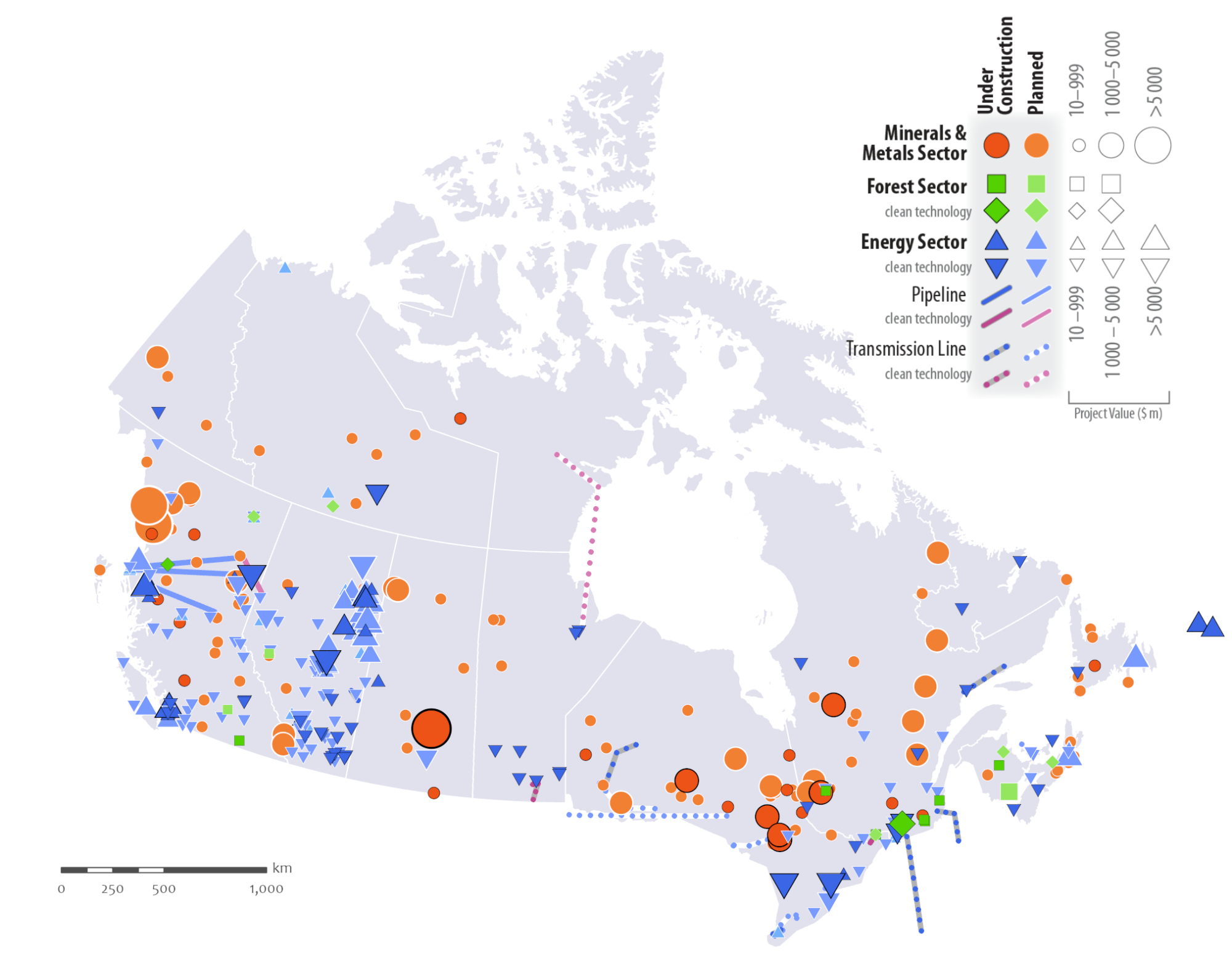
Prime Minister Mark Carney’s “nation-building” agenda has thus far largely focused on resource megaprojects. This is not a new thing. The policy agenda risks repeating a very old Canadian development pitfall that created the dependence on the larger empires of the world that leaves us vulnerable today. Rather than repeating the pattern of seeking salvation in megaprojects, the current moment calls for a public sector-led agenda to develop diverse, multi-sector economies that can adapt to changing economic circumstances.
The Staple Trap
Canada’s political economy is characterized by a longstanding struggle to develop systems of complementary technology and industries against the pull of resource extraction lock-in, referred to as the “staple trap.”1 The trap is set by resource extraction developments that require large, fixed cost infrastructures and the installation of other “rigidities” such as monopolies and political interests with influence over regional economies and political decision making. The dependent situation of regional economies on globally traded resources leaves them particularly vulnerable to shifts in international commodity prices or the political decisions made by empires in the world. External events create periods of crisis, and these crises appear particularly unexpected and severe.
The trap is tightened because of the way political leaders react during these crisis periods. The private sector seeks state protection, and the state and entrepreneurs respond by increasing resource exploitation. This means seeking new staple exports near at hand, with the state often playing the role of developing new “nation-building” infrastructure with the narrow purpose of exporting these staples. This reaction further strengthens the conditions for the staple trap – more large, fixed-cost infrastructure that must be paid off, the creation of monopoly interests, and dependencies on global empires to buy raw material exports.2
There Is Nothing New About Megaprojects
A focus on resource megaprojects is repeating a very old pattern. In 1957, economic historian W.T. Easterbrook said there was a “high premium on bigness in entrepreneurship”3 in Canada, describing how both governments and capitalists sought protection in megaprojects rather than a more evolutionary development pattern that uses innovative technologies to develop diverse economies.
Throughout Canada’s history, government decisions in reaction to external economic and military threats have often led to reinforcing dependency on resources. Canada has become a rich country and a middle power, but one with consistent underlying vulnerability and lack of sovereignty. A short review of Canadian economic history demonstrates that there is nothing new about the Carney government’s boosting of megaprojects.
When Canada negotiated free trade with the US, it created a new form of dependency in the emerging digital economy. The agreements had little to do with tariffs; they ensured that Canada supported US protectionism and dominance in intellectual property.
The first empire-based economy in Canada developed to serve European imperial markets and political interests, was the 16th century Atlantic cod fisheries. It was highly extractive and produced few developmental spin-offs, as fish harvesters only went ashore in the so-called “New World” to salt and dry their catches before returning to European countries across the Atlantic Ocean.4 The pattern was decentralized and flexible, and thus it did not install the rigidities associated with the staple trap.
The fur trade, beginning in the later 16th century that expanded as European fashion industries intensified in the 17th century, was also characterized by high extraction and limited settlement. Yet, the staple trap was being set because of the high fixed costs related to military agreements with First Nations and inter-colonial warfare. These burdens increased as trade expanded inland and westward from Atlantic coastal settlements to help pay these costs. Managing trade and violent economic competition over a vast geography led to the forced merger of the North West Company and the Hudson Bay Company in the early 1800s, introducing the trend of managing large-scale resource exploitation via large, centralized organizations answerable to private shareholders.5

By the 19th century, British North America oriented towards wheat and lumber exports to the British Empire. When Britain abolished trade preferences in a pivot towards free trade in the mid-1840s, there was a general feeling of “abandonment and disorientation.”6 Domestic lumber interests showed little support for Canadian independence, calling for annexation to the United States. This 19th century sentiment sounds familiar to Canadians today, but policymakers are still unprepared for this predictable situation. Once again, Canada’s most resource-dependent province expresses reluctant support for “elbows up” stance in the face of the US Trump Administration’s trade war and threats of annexation.
Avoiding the US Civil War by the 1860s reinforced Canada’s resolve to remain separate from the southern empire. US internal politics also protected Canada from annexation as southern US states at the time did not want non-slave Canadian colonies joining the Union, yet both Canadian corporate interests and Confederate interests supported free trade.
Canada’s 1867 Confederation was spurred by the continued threat of US attack after the Union victory. At the time, Canada also faced the loss of trade reciprocity with the US, as well as major debt burdens from building railroad and canal infrastructure taken up to reinforce its economy against the US. After Prime Minister Alexander Mackenzie’s failed attempt to re-negotiate free trade with the US, Prime Minister John A. Macdonald was re-elected in 1878 to introduce the National Policy of tariff measures meant to promote manufacturing and expansion into Western Canada.7
The railway construction through Canada’s first provinces, and its westward expansion, is often heralded as Canada’s first “nation-building” project. It surely supported Canadian territorial independence, yet there are lessons to learn because it was also characterized by a truncated form of developmental megaproject strategy, rather than a strategy to build a domestic innovation system. Policymakers, instead, focused on building infrastructure and managing associated debts, accommodating several private sector bailouts along the way.8 Furthermore, Canada’s banking system focused on short-term financing of railways, utilities, price arbitrage opportunities in resource rents, transportation, and tariff prices, rather than supplying long-term, patient capital for industrial development.9 Thus, Canada’s 19th century industrialization was led by foreign investors, and manufacturing was dominated by foreign companies that established branch plants.
During this period of industrialization, Germany and the US became leaders in the new technologies of steam, railways, precision engineering, and management of large corporate systems with policies such as industrial research programs and modern education systems in engineering and management.10 Canada’s National Policy did not build up the same institutions for technological and corporate leadership.
Still, the National Policy led Canada’s economic strategy until the Second World War, which introduced a mission too important to be left to the market. Canada’s federal government led industrial development through public enterprise and economic planning.11 This period represents a brief break from the staple trap pattern, where the Canadian state reacted to a crisis by directing the economy towards military-industrial development, rather than resource-based development.
Renewal of the staple export model was challenged in the post-war period because exports to Europe did not immediately revive to traditional levels. Instead of learning from the wartime planning experience, Canada opted for a new staple export strategy. Canadian policymakers negotiated preferential access to the US market, cementing a deeper dependency. A 1945 White Paper outlined a strategy for building a welfare state based on continued exports of staple products to the US and additional markets. In the 1950s, the federal government led to the development of the TransCanada pipeline and the St. Lawrence Seaway. Both infrastructure projects spurred nation-building sentiments, yet they were not coupled with a more ambitious industrial development agenda beyond the export of staples. Canada still had no government agency to lead industrial policy. A federal Department of Industry was eventually created in the 1960s, yet the primary strategy was one of export-led development.12
The Canadian economy remained vulnerable to external decisions. This vulnerability was highlighted in the 1971 “Nixon Shock,” which included a 10% tariff on all imports. US President Richard Nixon had also encouraged foreign branch plants to return home.13 The Pierre Trudeau government of the time announced a strategy to diversify Canada’s trade.
The 1970s saw provincial and federal governments create new Crown corporations to promote Canadian control of industries, such as aerospace and potash. A comprehensive discussion of industrial policy took place within the federal bureaucracy and advisory bodies, producing a vision of “technological sovereignty.”14 However, attempts to formulate and implement industrial policy were vetoed by the Department of Finance, and the federal government failed to produce a coherent policy direction.15
The federal government was ill-prepared for new crises that emerged in the early 1980s, when high interest rates slowed economic activity and oil prices fell from their previous spikes. The Pierre Trudeau government responded with a “megaproject” strategy, listing major capital projects that are eerily familiar to the Carney government’s strategy today. In 1983, public policy scholar Bruce Doern argued that the policy was largely performative because the government had to be seen to do something, yet had no coherent industrial policy in place.16 Progressive economist Duncan Cameron also argued that the strategy failed because it relied on attracting private capital rather than using public investment to spur industrial development through linkages with complementary sectors.17 The failure of this approach led to a retreat towards free trade with the United States, which was recommended by the Macdonald Commission in 1984.
When Canada negotiated free trade with the US, it created a new form of dependency in the emerging digital economy. The agreements had little to do with tariffs; they ensured that Canada supported US protectionism and dominance in intellectual property.18
The rise of digital technologies in the 1990s produced Canadian technology leadership through companies like Nortel and Blackberry, yet their emergence also engrained new dependencies. Federal policy focused on R&D and tax credits over more direct support for Canadian entrepreneurs in new economic sectors. For decades, there has been a pattern of Canadian technology start-ups that are immediately acquired by US firms before they are able to grow within Canada.19 Foreign technology companies located in Canada also benefit from highly skilled researchers, yet intellectual property is owned by foreigners – developing a trend of R&D extraction.20 These weaknesses in Canada’s innovation system were masked by high oil prices in the 2000s, as primary resource products made up a growing share of exports while technology fell behind.21 Prime Minister Mark Carney was not the first to declare Canada an “energy superpower” – Prime Minister Stephen Harper made the same declarations a decade earlier, and followed a policy of resource extraction over domestic innovation system building.22
The pitfall Canada may find itself in again is from a failure to implement a strategy to build up multiple sectors and new technologies for public benefit; where infrastructure is one component, but not the primary focus. The current “nation-building” strategy is closely tied to resource dependency.
The term “industrial policy” became popular during the decade of Prime Minister Justin Trudeau’s government, yet it failed to produce the institutions that could implement such a policy. For example, the Justin Trudeau government’s “supercluster” initiative focused on appeasing regional interests, rather than strategically shaping the geographically concentrated nature of innovation. The 2017 Strategic Innovation Fund passively invited applications, instead of developing the capacity within the public sector to lead a vision for industrial productivity and decarbonization. What the Justin Trudeau government called industrial policy, was often a defensive reaction to events in the United States. When the Biden administration released its Inflation Reduction Act in 2022, Canada reacted by implementing a similar tax credit policy, rather than realizing a coherent strategy for industrial development based on an analysis of Canada’s context.23
Megaprojects Versus Systems of Innovation
In the present day, Prime Minister Carney’s call for “nation-building” megaprojects is yet another reaction of the federal government to US policy – this time to US President Donald Trump Administration’s threats and tariffs. From a historical perspective, this is not a new thing. Most concerning, however, is that this strategy has never produced a sovereign Canadian economy but has installed new and dangerous rigidities that invoke new dependencies for resource products, continuing to leave Canada vulnerable to foreign decisions and global economic instabilities.
A system of innovation agenda would not stop natural resource development or refuse to build infrastructure, but the agenda’s primary focus would be to analyze the opportunity to develop related sectors instead of expanding the export of raw material or semi-processed resources.
The primary concern is not itself with megaprojects or infrastructure. The pitfall Canada may find itself in again is from a failure to implement a strategy to build up multiple sectors and new technologies for public benefit; where infrastructure is one component, but not the primary focus. The current “nation-building” strategy is closely tied to resource dependency. The primary policy is a major projects office that seeks to help the private sector navigate environmental and other public protections or, more cynically, to remove them. Reacting to economic threats by speeding up megaproject approvals suggests policymakers think it is possible to short-circuit an evolutionary development process where technology and organizational innovations are guided through stages of experimentation and growth across multiple sectors.
The way to escape the staple trap pattern is to develop systems of innovation – diverse economies where multiple sectors interact to develop, use, and expand technology. These systems of innovation can be directed to develop Canadian technology used to solve Canadian problems. They can be built from local community assets, knowledge, and novel inter-sectoral combinations and, therefore, do not have to be based on natural resource exploitation. Government plays a role in actively monitoring and building up these systems over time; thus, it is a consistent development policy rather than a short-term reaction to a crisis.
A system of innovation agenda would not stop natural resource development or refuse to build infrastructure, but the agenda’s primary focus would be to analyze the opportunity to develop related sectors instead of expanding the export of raw material or semi-processed resources. There are also historical examples in Canada of developing systems of innovation that have led to long-term, sustainable outcomes. The development of large hydroelectric projects in Québec, for instance, spurred innovation in long-distance transmission, and was coupled with the creation of a public utility, a research institute, and the social goal of technological sovereignty. Québec used hydroelectricity to build a relatively more diverse inter-sectoral system compared to the rest of Canada, which included the growth of aluminum and chemical sectors, procurement policies that facilitated the engineering sector, and a research infrastructure responsible for the early development of the lithium iron phosphate battery.24
The focus on megaprojects in a “nation-building” agenda is Canada’s traditional reactive response, stemming from the inadequacies of previous policy agendas and the perception that there is nowhere else to maneuver other than doubling down on resource dependency.
Looking beyond resources and infrastructure, there are new development pathways. Verafin is a Newfoundland company that used artificial intelligence to guide underground mining vehicles, which then applied the same technology to bank security fraud detection.25 An agenda that prioritizes systems of innovation would seek out more of these applications for new technologies with resource sectors, and develop the adjacent economic development pathways. This has the potential to home grow Canadian companies and give them the ability to remain in Canada.
Systems of innovation could be guided by public purpose missions. It is possible to create economic opportunities from numerous publicly coordinated projects, not just natural resource exploitation projects. To truly protect Canadians from the uncertain world order, “nation-building” should focus on securing basic human needs such as housing, food, and access to digital infrastructure. Nation-building should consider building affordable and healthy homes capable of withstanding power outages, food sovereignty, and digital sovereignty for Canada. These initiatives need public sector organizations to establish missions, create partnerships, and support promising Canadian solutions.
The irony is that many of these innovation system-building strategies could start to deliver results sooner than megaprojects. What Canada lacks is the institutional infrastructure, and related policy focus. The staple trap pattern means that Canada fails to develop these institutions in good times facilitated by steady resource exports and then retreats to expanding resource exploitation during crises. Institutions to build a different and diverse economy need to be supported over the long-term to protect the economy when the next crisis occurs.
Other nations have developed leading industrial policy and research institutions like Japan’s former Ministry of International Trade and Industry (MITI), Germany’s Fraunhofer Institute, Sweden’s Vinnova, or the US Defense Advanced Research Projects Agency (DARPA) that guide innovation and economic system building efforts. Canada has not developed or adequately supported similar institutions, though there have been attempts and important exceptions, such as the federal government’s Industrial Research Assistance Program first implemented in the 1960s.
From Reactive “Nation-Building” to Consistent Economic Development
An agenda to truly strengthen Canada’s economy would seek to build systems of innovation instead of megaprojects. The focus on megaprojects in a “nation-building” agenda is Canada’s traditional reactive response, stemming from the inadequacies of previous policy agendas and the perception that there is nowhere else to maneuver other than doubling down on resource dependency. If history is to serve as a guide, this reactive response is unlikely to produce an independent and resilient Canadian economy. An alternative agenda would recognize that the state must play a consistent and long-term role in economic development. It is a task too important to be left to the private sector. Nation-building would focus on meeting the core needs of Canadians to weather future economic and political storms and actively use public purpose missions to develop a diverse set of Canadian technologies, businesses, and worker skills.
Notes
- Mel Watkins, “A Staple Theory of Economic Growth,” Canadian Journal of Economics and Political Science 29 (1963): 141–58. ↩︎
- Described in Brendan Haley, “From Staples Trap to Carbon Trap: Canada’s Peculiar Form of Carbon Lock-In,” Studies in Political Economy 88 (2011): 97–132. ↩︎
- W. T. Easterbrook, “Long-Period Comparative Study: Some Historical Cases,” The Journal of Economic History 17, no. 4 (1957): 571–95. Page. 579 ↩︎
- I acknowledge that Duncan Cameron made this point in his presentation at “Elbows Up in the Long Arc of Canadian Political-Economy” Elbows Up Economic Summit, Canadian Centre for Policy Alternatives, September 14, 2025, Ottawa. Available online. ↩︎
- Harold Innis, The Fur Trade in Canada (University of Toronto Press, 1930). ↩︎
- William Thomas Easterbrook and Hugh G. J. Aitken, Canadian Economic History (Macmillan, 1956). Pg. 353. ↩︎
- Easterbrook and Aitken, Canadian Economic History. Chapter 16. ↩︎
- Laurent Carbonneau, At the Trough: The Rise & Rise of Canada’s Corporate Welfare Bums (Sutherland House, 2025). ↩︎
- R. T. Naylor, The Rise and Fall of the Third Commercial Empire of the St. Lawrence, ed. Gary Teeple, Capitalism and the National Question in Canada (University of Toronto Press, 1972), 1–43. ↩︎
- Chris Freeman and Luc Soete, The Economics of Industrial Innovation, Third Edition (MIT Press, 1997). Chapter 12. ↩︎
- See recent article in Robert Chrnomas and Fred Wilson, “Elbows up: Industrial National Strategy,” in Elbows up: A Practical Program for Canadian Sovereignty, ed. Jim Stanford and Peggy Nash (Canadian Centre for Policy Alternatives, 2025). Seth Klein, A Good War: Mobilizing Canada for the Climate Emergency (ECW Press, 2020), Available. ↩︎
- David Allan Wolfe, “The Delicate Balance: The Changing Economic Role of the State in Canada” (University of Toronto, 1980), Available online; David Wolfe, “The Canadian State in Comparative Perspective,” Canadian Review of Sociology/Revue Canadienne de Sociologie 26 (1989): 95–126. ↩︎
- Rianne Mahon, The Politics of Industrial Restructuring: Canadian Textiles (University of Toronto Press, 1984). ↩︎
- John N. H. Britton and James M. Gilmour, The Weakest Link: A Technological Perspective on Canadian Industrial Underdevelopment (Science Council of Canada, 1978); Science Council of Canada, Forging the Links: A Technology Policy for Canada (Science Council of Canada, 1979); Science Council of Canada, Canada as a Conserver Society: Resource Uncertainties and the Need for New Technologies (Ottawa, 1977). ↩︎
- Richard D. French, How Ottawa Decides: Planning and Policy-Making 1968-1980 (James Lorimer and Company/Canadian Institute for Public Policy, 1980). ↩︎
- Bruce G. Doern, “The Mega-Project Episode and the Formulation of Canadian Economic Development Policy,” Canadian Public Administration 26, no. 2 (1983): 219–38. ↩︎
- Presentation at “Elbows Up in the Long Arc of Canadian Political-Economy” Elbows Up Economic Summit, September 14, 2025, Ottawa. ↩︎
- Duncan Cameron, “Elbows up, Then and Now: The Historical Context for Canada’s Struggle for Economic Independence,” in Elbows up: A Practical Program for Canadian Sovereignty, ed. Jim Stanford and Peggy Nash (Canadian Centre for Policy Alternatives, 2025). ↩︎
- David Wolfe, A Digital Strategy for Canada: The Current Challenge (Institute for Research on Public Policy, 2019), Available online. ↩︎
- Chris Lamb and Daniel Munro, “A Rise in Software-Related R&D Spending Is a Promising Trend,” Policy Options, March 3, 2021, Available online. ↩︎
- Jim Stanford, “Staples, Deindustrialization, and Foreign Investment: Canada’s Economic Journey Back to the Future,” Studies in Political Economy, no. 82 (December 2008); Jim Stanford, Building a Sovereign, Value-Added, and Sustainable Economy, August 18, 2025, Available online. ↩︎
- Tony Clarke et al., The Bitumen Cliff: Lessons and Challenges of Bitumen Mega-Developments for Canada’s Economy in an Age of Climate Change (Canadian Centre for Policy Alternatives, 2013). ↩︎
- Brendan Haley, “Will the Response to the US Inflation Reduction Act Reveal Canada’s Lack of Green Industrial Policy?,” Broadbent Institute, March 19, 2023, Available online. ↩︎
- Brendan Haley, “Low-Carbon Innovation from a Hydroelectric Base: The Case of Electric Vehicles in Québec,” Environmental Innovation and Societal Transitions 14 (2015): 5–25; John Harkness Dales, Hydroelectricity and Industrial Development: Quebec 1898-1940. (Harvard University Press, 1957); Karl Froschauer, White Gold : Hydroelectric Power in Canada (UBC Press, 1999). ↩︎
- The company provides a familiar story of foreign acquisition. It was sold to Nasdaq. Yet, it plays an important role in seeding the St. John’s digital technology ecosystem. ↩︎