Lingering fears of United States domination over Canada’s economic and political institutions, concerns about rapid technological advancement and the surges in alienation and unemployment it entails, youth-led protests against US atrocities supported by Canadian funds and arms, and a resurgent Canadian left are familiar crises and movements to different generations. In the late 1960s, Canadian political economists Mel Watkins and James Laxer organized left-wing members of the New Democratic Party to publish a document entitled Manifesto for an Independent Socialist Canada, responding to the era’s pressing questions and to push the NDP to become a vehicle for the policies they believed were necessary to avoid US domination over Canada. To move the country beyond the post-war welfare capitalist state, they introduced a program that focused on workplace democracy and public ownership of the “commanding heights” of the Canadian economy.1 The Manifesto and the so called “Waffle” movement behind it were not widely well-received. Many NDP members were hesitant to accept these radical proposals from their perspective. Labour leaders feared reprisal, with many of their members working for the US “branch plants” that the Waffle’s manifesto critiqued. Other political parties were ready to dismiss the NDP as too extreme for Canadians, were a Waffle Manifesto to be adopted.
Despite status quo opposition, the Waffle’s pressure put forward an economically nationalist agenda, leading to substantial policy change for the NDP throughout the decade. The Waffle’s purging from the party was followed by a hollowing out of the NDP’s intellectual base and the grassroots support for economic nationalism in Canada. In today’s era of further US decline amid the structural crises of modern capitalism and technological alienation, the Waffle’s ideological project proposes a coherent and relevant response to the crises faced by 21st century Canadians. The New Democratic Party of Canada has a unique opportunity, under new leadership, to change course and chart a path forward that draws on the best of the Waffle’s tradition to confront current challenges.
The Canadian New Left Moment
In the 1960s and 70s, inspired by Third-Worldist movements and the US Civil Rights Movement, socialist youth movements composed of relatively well-off, white students, known as “the New Left,” emerged across the West. Radicalized by US imperialism globally, democratic repression within the Soviet Bloc countries, as well as alienation from the post-war consensus of the Fordist economic model of capitalism, the New Left emerged out of movements and organizations developing new and liberatory experiments in governance. From the streets of Paris to the National Mall in Washington DC, New Left movements defined leftist political thought during this period.
Laxer grew up in the generation amid these movements, becoming engaged in activism through the Cold War peace movement against US military intervention around the world. He grew frustrated by the adoration that Canada’s New Left held for their US counterparts and was wary of the lack of organizational structure among the Canadian movement. While these movements grew during the 1960s, Laxer believed that the only way forward for the Canadian left was to organize and create a Canadian vision for the structure of society that addressed the unique issues of economic and social sovereignty of Canada and Quebec.
In 1968, Watkins had finished leading the federal government’s Task Force on Foreign Ownership and the Structure of Canadian Investment. Selected to chair the Task Force for his apparent moderate & continentalist leanings, his research through this assignment changed his views in favour of economic nationalism.2 The Task Force’s official recommendations called for restrictions on foreign (particularly US) ownership of national businesses and natural resources, as well as the curation and expansion of Canadian capital. NDP Leader Tommy Douglas endorsed the document in the 1968 federal election, yet Watkins himself underwent a radical political transformation.3 Watkins came to argue that Canadian capitalists were naturally subservient to US capitalists, taking profits by selling Canadian natural resources to US interests and supporting US investments in Canada. The only path to economic independence would be through state ownership of the economy, in direct partnership with workers and unions. In the wake of the global 1968 turbulence, Professor Gerald Caplan invited Laxer, Watkins, Ed Broadbent, and other key NDP members to synthesize the fledgling social & nationalist movements into a coherent vision for the future of the struggling party.
They also argued that only a Canadian socialist agenda would resolve the fears and anxieties of the age; including the nascent question of Quebec as a nation after a decade of the province’s Quiet Revolution.
In 1969, this core group drafted the Manifesto for an Independent Socialist Canada, opening with a stark warning that, “the major threat to Canadian survival today is American control of the Canadian economy.”4 The Manifesto proclaimed that Canada had replaced subservience to the British Empire with the American Empire through its complicity in the war on Vietnam through arms sales, a deferential corporate capitalist class, the country’s reduction to a resource base and consumer market. Based in part on Broadbent’s earlier work on workplace democracy,5 they emphasized the necessity for Canada to seize the commanding heights of its industries and empower workers to democratically control the day-to-day operations of their labour. Claiming this would reduce the inherent alienation of workers from their means of production and ease the increasing alienation people faced with quickening technological advancements: “sheer size combined with modern technology further exaggerates man’s sense of insignificance and impotence. A socialist transformation of society will return to man his sense of humanity, to replace his sense of being a commodity.”6
The Waffle believed that the NDP must advocate for a world beyond the post-war welfare state as it was nearing exhaustion, and its contradictions culminated in outbursts out on the streets of Selma and Saigon. Capitalism of the time continued its reliance on the unpaid labour of women, the oppression of ethnic minorities, the hollowing out of rural & small-town living in favour of hubs of concentrated capital, and a tendency towards corporate monopoly. Taking cues from second-wave feminist and women’s liberation movements in the US, the Waffle also advocated for women’s empowerment within the NDP. They believed in prefigurative politics in that, to democratize society, the NDP must first democratize itself. They demanded a shift from the top-down structure of unions, political parties, and organizations of the 20th century, to empower members and ensure that their executive bodies were more representative, at the time, advocating for at least 25% of spots on the executive of the party to be held by women.7
They also argued that only a Canadian socialist agenda would resolve the fears and anxieties of the age; including the nascent question of Quebec as a nation after a decade of the province’s Quiet Revolution. The Waffle believed that Canada held two nations (deux nations) and supported Quebec’s right to self-determination. A core issue behind national unity was that English Canada had forged dangerously intimate ties with a dominating US culture and therefore risked weakening Anglo Canadian and Quebec culture. To resolve these contradictions, the Waffle demanded that Canada reassert itself as a distinct society, separate from the US, and support Québécois culture to defend this distinction.
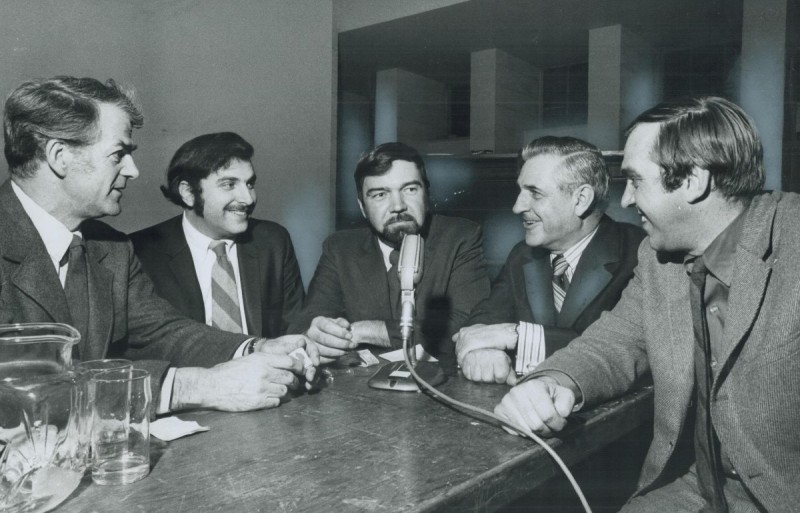
The Waffle Manifesto ignited debate almost immediately. Although controversial with party leadership and affiliated unions, it caught the attention of the media and the Canadian social movements emerging out of the 1960s. With the aim of influencing change at the NDP’s 1969 Convention in Winnipeg, Waffle members began organizing long-time members and new membership sign-ups. Waffle groups formed across Canada, signing on NDP electoral district associations and party apparatus such as the Ontario New Democratic Youth onto the Waffle Manifesto. The movement quickly built organizational capacity capable of impacting the institutional mechanisms of the party convention. MPs and the party executive, who were initially friendly to the Manifesto, saw the growing movement and began to baulk against it. Broadbent would distance himself from his contribution to the Manifesto, fearing that the document had become too rhetorically extreme and academic to appeal to working-class voters.8 Ontario MPP Stephen Lewis, who “came fairly close to signing” the Manifesto due to his sympathies with the program it outlined did not respond to his invitation to the initial Waffle meeting after deliberation with his father, MP David Lewis.9
David Lewis cautioned against the radical sentiments of the Manifesto. As a child during the Russian Revolution, a family tradition within the Jewish Labour Bund, and through his experiences as a refugee when his family fled to Montreal in 1921 due to his father Morris’ distrust of Bolshevik rule, the elder Lewis developed an aversion to the rhetoric of the Waffle.10 His distaste for the radical left was also driven by his 1943 run as a CCF candidate for the Cartier district by-election in Montreal, where he faced a vicious campaign that was won by Fred Rose and the communist Labour-Progressive Party. Despite his aversion, when other party executives suggested cancelling the vote on the Manifesto at the 1969 convention, David Lewis insisted that the party must debate the document.11 His response was to produce a more moderate Manifesto put forward by philosopher Charles Taylor, entitled For a United and Independent Canada, nicknamed the “Marshmallow Manifesto” for its softer tone.
The stage had been set for the 1969 NDP Convention. A clear generational and class divide emerged from the debate, with student activists and academics pushing for the Waffle Manifesto, and older trade union members, experienced party members, and the NDP caucus arguing against its adoption. NDP Leader Tommy Douglas leaned more towards acceptance of the Manifesto’s principles than his caucus members did, emphasizing the need for independence, public ownership, and economic planning.12 Although the Manifesto failed by a vote of 499 in favour to 268 against of delegated convention members, the Waffle group felt confident in their convention gains, staking out NDP policy positions closer to their agenda, as well as seats among the party executive. They also garnered a wave of media attention for their issues and quickly became a force for the Canadian New Left, pushing the adoption of issues like nationalization and public ownership NDP that the NDP had neglected since the post-war Red Scare that had spilled into Canada from the US.
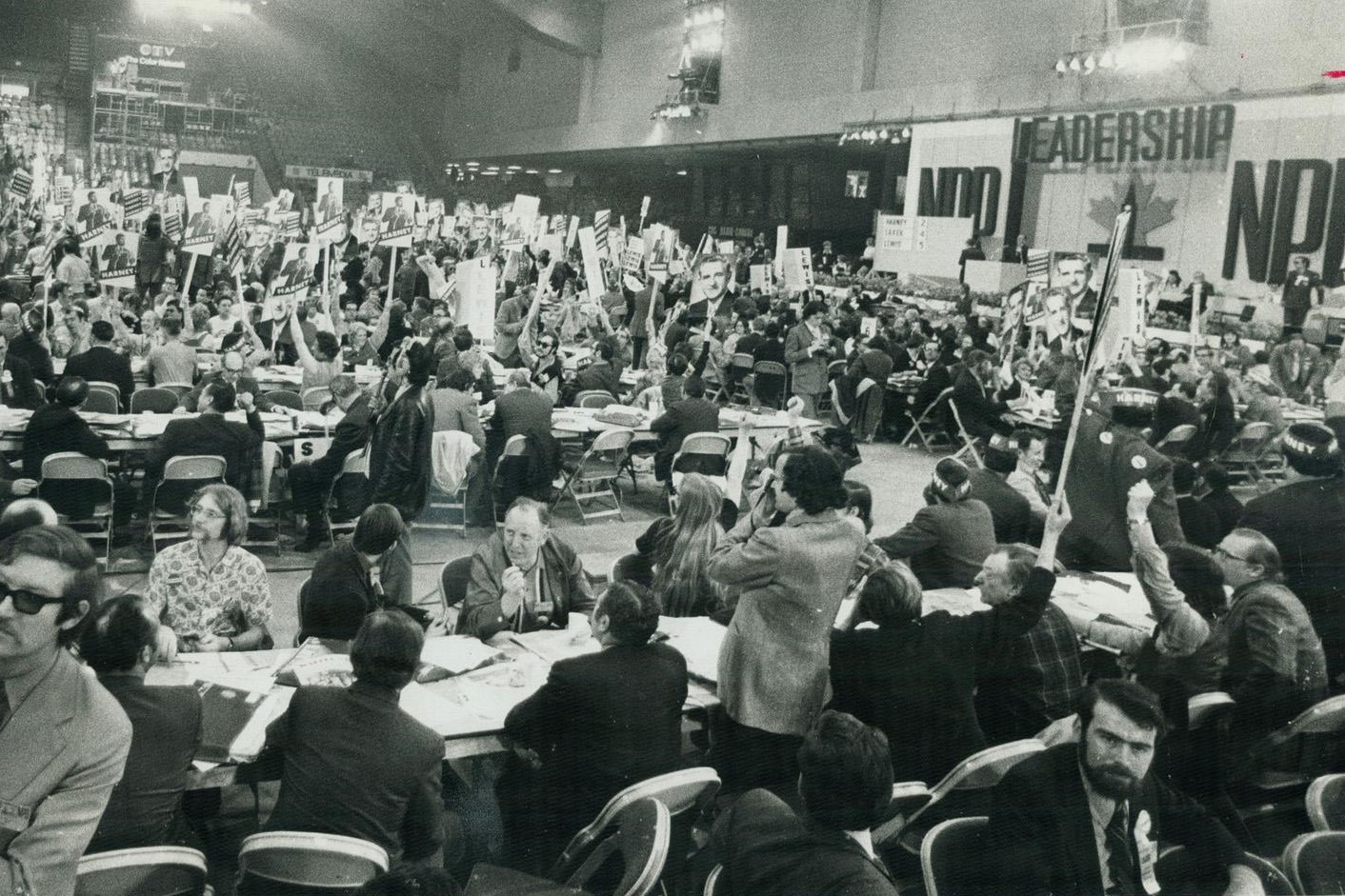
While the 1969 Convention could be seen as a cordial debate between two sides, the 1971 NDP Leadership Convention involved severe tensions on the question of the Waffle. Tommy Douglas’ resignation after a decade of leadership opened the future direction of the party. After the 1969 Convention, and with the earned attention since, the Waffle continued organizing and growing across Canada. MPs Ed Broadbent and Frank Howard entered the leadership race, alongside York University Professor John-Paul Harney. Although originally abstaining, David Lewis eventually joined the 1971 Leadership Race, and so did the Waffle’s James Laxer.13 Laxer and Lewis clashed over Quebec’s right to self-determination and the Manifesto’s fundamental issue of nationalization. Lewis, who had recently drawn praise for his principled stance against the invoking of the War Measures Act by Pierre Trudeau during the 1970 October Crisis, claimed that Quebec already had the right to self-determination and that the messaging on the issue by the Waffle was equivalent to boosting separatists. These claims were legitimized in that the Waffle attempted to form connections with the new separatist, social democratic Parti Québécois.14 Lewis also attacked the blanket use of nationalization as a quick-fix policy prescription on the issue of sovereignty.
The anti-Waffle party establishment and labour union faction learned from the 1969 Convention and organized itself into “NDP NOW” in 1971 to vote down Waffle-affiliated motions and candidates. By the time delegates met in Ottawa, tensions had reached a critical point. Feminist Wafflers recalled misogynistic epithets hurled at them during a defeated motion for gender parity on the party executive.15 Waffle-supported motions were voted down, with none of the conciliatory shifts in support from the previous convention. When it came to the leadership election, Laxer shocked NDP delegates by placing second in the first round of the race, with no majority among the four convention contenders. Laxer faced Lewis alone by the final fourth ballot, receiving only 37% of delegate votes, while 63% coalesced around Lewis. Although Lewis was proclaimed the victor, the Waffle was energized; Watkins even identified it as one of the greatest days of his life, seeing victory amid the defeat.16 To Watkins and the Waffle, Lewis was an institutional giant who was expected to dominate the race, but was instead defiantly contested to a fourth-round finish. The victors felt defeated in the contested reality they faced, while the losers felt jubilant coming this far against the odds.
The Waffle had set its next target on organizing with labour, to bring them onside despite their stubborn opposition during previous conventions, by forming the “Waffle Labour Caucus.” Tensions continued to grow as the Waffle organized its members to support strikes and distributed pamphlets to workers calling them to reject their transnational, US-dominated unions, in favour of “independent” Canadian unions, to decouple US institutional influence from the Canadian movement.
Meanwhile, cracks began to form in the Waffle’s coalition. During the 1971 Ontario election, Ontario NDP leader Stephen Lewis clashed with Waffle candidates who had won multiple nomination contests across the province to represent the ONDP.17 Falling short of expectations in failing to replace the ailing Ontario Liberal government, which was superseded by the Bill Davis Progressive Conservatives, the younger Lewis was quick to blame the infighting as one source of the defeat. The internal conflict began to spill into the public, with blame levied back and forth for the disappointing result. Stephen Lewis described the Waffle as an “encumbrance around my neck.”18 Labour union leadership increasingly began pushing Lewis to deal with the Waffle’s expanding presence within the Ontario party as the Waffle formed connections with Steelworkers and UAW locals, as well as a reform caucus within the CLC that urged them to radicalize their demands and splinter from their US counterparts.19
On the Prairies, Waffle organizations had become frustrated with the lack of progress by the Ed Schreyer government elected in Manitoba in 1969, and the Allan Blakeney government elected in Saskatchewan in 1971, and began advocating for a hard split from the provincial wings of the NDP. In the meantime, Trotskyists had seized the Waffle organization in New Brunswick in 1971 and used it as a vehicle to take over a fledgling New Brunswick NDP, prompting the federal party to intervene. Watkins and Laxer, seeing conflict spill into the open over defeat in Ontario, were further discouraged by reports from other parts of the country. Laxer stated his commitment to remaining within the NDP while Watkins condemned the New Brunswick Waffle as “totally unacceptable… laying beyond the pale of social democracy.”20
At a Provincial Council meeting in 1972, Stephen Lewis declared that the Waffle was acting as a “party within a party”21 and classified this position as untenable. While David Lewis urged Stephen and the Ontario NDP executive not to purge the Waffle from the party,22 arguing that it would cause lasting internal damage, David Lewis, along with Alberta NDP Leader Grant Notley, instead sought compromise that allowed the Waffle to soften its edges while remaining within the NDP. Stephen Lewis maintained his stance on purging the Waffle from the ONDP, stating that he was under pressure from labour leadership that could lead to end of their support, and funding, of the Ontario party if the Waffle was not removed.23 At the following provincial council meeting in Orillia, pleas from both sides were voiced, compromises were offered, but when time came for the final vote, the council voted 217 to 81 to force Waffle members to renounce their membership of the Waffle or face expulsion from the New Democratic Party. Laxer and Watkins accepted this vote and resigned from the party, effectively ending the Waffle within the NDP.
Aftermath
After their purge from the Ontario NDP, the Waffle’s influence remained. Pushing the issue of US economic domination to the forefront weighed on the policymaking of Pierre Trudeau’s governments. Beginning with the implementation of cultural controls, through minority and majority parliaments, the NDP pressured the Liberal government to implement Canadian content quotas. During this time, the Trudeau government implemented the Foreign Investment Review Act in 1973, which regulated takeovers and buyouts of Canadian businesses by US and other foreign capital interests. Waffle-style nationalization came to the fore with the establishment of Petro-Canada as a Crown Corporation and the National Energy Program, showing an alternative way to address the 1973 Energy Crisis.24
As neoliberal globalization took hold, Canadian economic nationalism was hollowed out, and the Waffle’s warnings became reality.
With the election of Brian Mulroney in 1984, many of these policies were quickly reversed as the neoliberal agenda of free trade with America, and privatization took root.25 A lack of political will and institutional support for these policies caused them to flounder, and the ending of the Waffle’s influence left a vacuum for defending national economic policies. Opposition to the NEP and Petro-Canada was organized, with large financial interests supporting campaigns opposing the policies. As neoliberal globalization took hold, Canadian economic nationalism was hollowed out, and the Waffle’s warnings became reality. Free trade agreements with the United States, economic and military dependence on the US, and the privatization of industries and infrastructure accelerated and normalized without concerted opposition. Today, Canada’s economy reels as the Trump Administration implements its own national economic policy while Canadian wellbeing is evermore tied to the whims of US capital. The trade regime that accelerated Canada-US integration that undermined economic and democratic sovereignty for Canadians has meant unending waves of economic crisis since the 2000s.
A decade after stepping down as leader of the federal NDP, David Lewis remarked, “when the Waffle left the party, so too did most of the brains with them.”26 To the party leadership, it was clear that the purge of the Waffle left an intellectual and political vacuum in the party that had not been filled. Ripping out a force for democratic debate within the NDP encircled a further professionalization of the institution that carried on for decades, without the intellectual rigour or organizing appeal to build a mass movement. Even among opponents of the Waffle at the time, there are anecdotes reflecting on how lively and energetic the conventions they contested were. This democratic energy gave life to the party, even though the Waffle’s motions mostly failed to pass, pushing those on opposite ends of these struggles to craft their own policies, arguments, and strategies, making every section of the party stronger for it.
The Waffle’s advocacy still reverberates to this day. Waffle feminists fought for gender parity, stating that women, “need special representation on party bodies to both speak to women’s issues and to criticize male chauvinism within the party, just as labour needs special representation…”27 These demands were won, paving the way for party activists in ethno-racial, Indigenous, and disabled communities to also demand substantial representation. The Waffle’s position on Quebec’s right to self-determination that had caused such controversy became party policy, echoed in the 2005 Sherbrooke Declaration which was in part responsible for the Quebec breakthrough of the 2011 federal election.
Tommy Douglas stated that, “the time to worry is when a convention turns into a mutual admiration society.”28 One can see this realized in the modern NDP, perhaps resulting from an apparent lack of tolerance for internal dissent since the Waffle. This mutual admiration society saw its worst defeat ever during the 2025 federal election, where the NDP could not even hold on enough seats to maintain party status in Parliament.
In an ironic twist of history, Avi Lewis won a resounding vote for leader of the NDP at the 2026 Winnipeg Convention on a strategy and message like that laid out by the Waffle in that same city 57 years ago. Running on a platform that prioritized the democratization of the NDP, cutting military and economic ties with the United States, crafting Crown Corporations in major industries, reining in wealth and technological advancements, and promoting worker ownership, the Waffle’s requiem in 1972 may have proven to be premature. The leadership campaign viewed the party as the parliamentary voice for broader social movements, vowing to repair ties after past disappointments, and set up extra-party regional organizations to sign up members and engage with the public on central campaign issues.
There are, however, differences. Where James Laxer and the Waffle saw victory in second place after four rounds of ballots at the 1971 Convention, Avi Lewis won his race on the first ballot with 57% of the vote. The new Lewis leadership, won by a coalition of youth, experienced party members, climate activists, and rank-and-file labour members, has proven to be much stronger than the students and academics borne from the 1968 watershed. As similar as the crises then may appear to today, however, they are arguably worse today. Inflation has lasted much longer and extreme inequality has seen the emergence of the world’s first trillionaire. US military conflict in the Middle East culminates in genocide and an unprecedented global energy crisis that has accelerated decarbonization efforts. Instead of concerns of Canadian cultural displacement by US TV programs, Canada faces pervasive US Tech Giants and explicit threats of being taken over as the “51st state.” The material conditions that led to the Long Sixties have, in many respects, worsened, and as such, the appetite for a truly left-wing mass political party has only since deepened.
However, the ease with which Avi Lewis has been able to take hold of the party compared to the Waffle could also be attributed to its weakness. Previous Lewis leadership maintained the institutional backing from labour unions, which organized members to attend and participate in building the party at conventions, EDA meetings, and more. While there is still an official presence for labour within the party, there are regular proclamations that the working class has abandoned the NDP today. However, the 2026 Lewis campaign also focused on newer hubs of workplace organizing, such as the gig and care economies. Furthermore, the campaign may have been helped by a hollowing out of the NDP’s “establishment” because of their 2025 loss.29 The party lost funding for staff, researchers, and other resources that could not be leveraged for more institutionally-friendly leadership candidates. Avi Lewis has now made it farther than the Waffle ever had, though the conditions for the party are at perhaps the lowest they have ever been. The dormant Waffle may have been re-awakened, but its dreams for a sovereign, socialist Canada face new 21st century challenges.
Notes
- For a Democratic and Socialist Canada, 1969. ↩︎
- Christina Newman. “How Mel Watkins brought socialism to the NDP,” Saturday Night. September 1970, pp. 24. ↩︎
- Newman. “How Mel Watkins brought socialism to the NDP,” Saturday Night, pp. 26. ↩︎
- For a Democratic and Socialist Canada, 1969. ↩︎
- Ed Broadbent, Frances Abele, Jonathan Sas, Luke Savage, Seeking Social Democracy, ECW Press, October 10 2023, pp. 31. ↩︎
- For a Democratic and Socialist Canada, 1969. ↩︎
- D.J. O’Donnell, “Women Organize in NDP”, The Pedestal, Winter 1969, Simon Fraser University Associates. ↩︎
- Broadbent, et. al., Seeking Social Democracy, pp. 25. ↩︎
- J.T. Morley, Secular Socialists: The CCF/NDP in Ontario, A Biography, McGill-Queens University Press, 1984), pp. 211. ↩︎
- David Lewis, The Good Fight: Political Memoirs 1909-1958, Macmillan of Canada, Toronto, 1981, Chapter 1. ↩︎
- Drummond Burgess, Robert Chodos, Margaret Davidson, “David: The Centre of His Party”, The Last Post, April-May 1971, pp. 30. ↩︎
- Gregory Marchildon, Tommy Douglas and the Quest for Medicare, University of Toronto Press, 2024, Chapter 1. ↩︎
- “Waffle backs Laxer to run in NDP race,” The Globe and Mail, December 1, 1970. ↩︎
- “Allow Quebec to secede, Waffle group proposes,” The Globe and Mail, January 16, 1971. ↩︎
- John Zaritsky, “NDP vetoes a conference to plan program for females,” The Globe and Mail, April 26,1971. ↩︎
- John Zaritsky “The jubilant Waffle sees victory in NDP convention defeat,” The Globe and Mail, April 26, 1971. ↩︎
- “Lewis assailed by Wafflers,” The Globe and Mail, September 30, 1971. ↩︎
- Stephen Lewis, “James Laxer and Stephen Lewis on the Waffle’s Demise”, CPAC, April 13, 2013. ↩︎
- James Laxer, “James Laxer and Stephen Lewis on the Waffle’s Demise”, CPAC, April 13, 2013. ↩︎
- “N.B. Leftist Plan ‘Was Unacceptable’,” The Telegraph-Journal, 5 April 1972. ↩︎
- Lewis, “James Laxer and Stephen Lewis on the Waffle’s Demise.” ↩︎
- Morley, Secular Socialists, pp. 217. ↩︎
- Ibid., pp. 216. ↩︎
- Broadbent, et. al., Seeking Social Democracy, pp. 46. ↩︎
- Ibid., pp. 60. ↩︎
- Reg Whitaker, “The 20th Anniversary of the Waffle – Introduction,” Studies in Political Economy 32, Summer 1990, pp.170. ↩︎
- O’Donnell, “Women Organize in NDP”, The Pedestal. ↩︎
- “Douglas thanks the radicals,” Toronto Star, November 1969. ↩︎
- Martin Lukacs, “What Does Avi Lewis’s Win Mean for Socialists?” Victor’s Children, Podcast, April 9, 2026. ↩︎