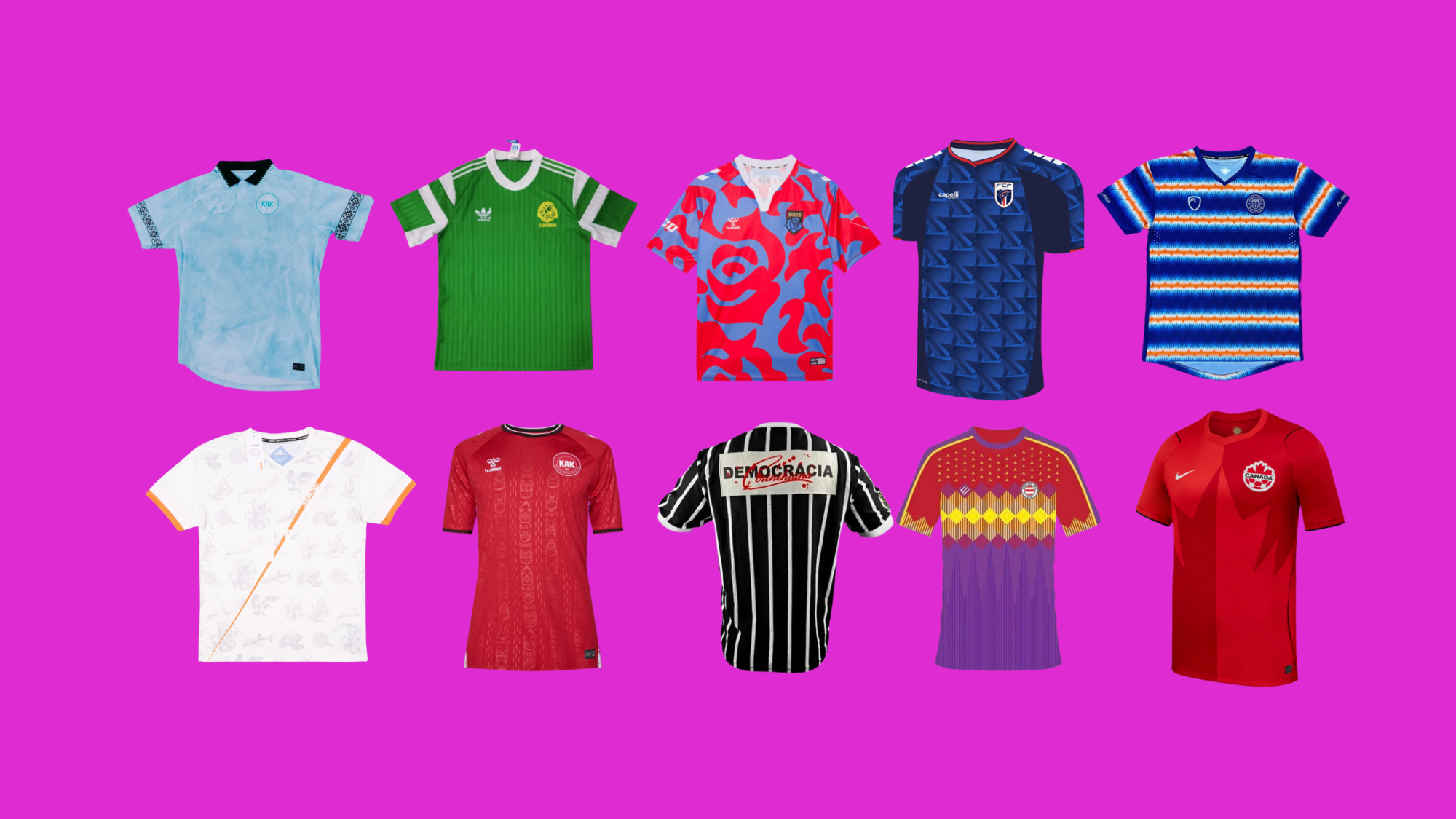
Early in 2026, I bought my second Greenland soccer jersey (the light blue, ice-patterned away kit) the day that US President Donald Trump posted an AI-generated image of himself planting a US flag on a Greenland landscape. He followed up later that day, posting another generated image featuring Europe’s leaders around his desk in the Oval Office, considering a map where both Greenland and Canada are overlaid with the American flag.
As acts of resistance go, buying a soccer jersey is pretty silly. It is just a piece of clothing, after all, and not even one with a political message. But over the last few years I have, rather unintentionally, built up a collection of soccer jerseys that have become a kind of armour for me against the increasingly horrifying direction of our world.
It was my father’s old green Cameroon jersey that started off my collection. I found it, oversized, wrinkled, and forgotten, at the bottom of a drawer. It was one of the many t-shirts I inherited from my father after he died, but there is something special about this one. He bought the jersey during the 1990 FIFA World Cup, the first one I ever watched, when the Cameroon squad made their legendary run to the quarter-finals – further than any African team had gone before. My father loved watching them defy expectations and, like so many others, he was smitten with Roger Milla – the team’s star player who, at 38, became the oldest goal scorer in World Cup history at that time.
That tournament shaped the kind of soccer fan I am. Like my father, I have a fondness for some teams, but no hard and fast allegiances. What I am loyal to is cheering for the underdog; for the team that has the odds stacked against it. Wearing my dad’s old Cameroon shirt reminded me of why I side with them. Watching an underdog team, every goal, every blocked shot, every flash of individual brilliance and every moment of intricate team play feels bigger than the game, and that feeling lasts far beyond the final whistle.
I wonder if the promise of an underdog victory is part of the reason I have been drawn more obsessively to soccer in recent years? These kinds of victories don’t happen often. Soccer, like geopolitics, is not always played as an even matchup. So, when these victories do happen, they unlock a joy that infects other parts of my life.
After I wore my father’s 1990 Cameroon kit a few times, folded and pinned to try to create some semblance of shape from the oversized men’s fit, I decided it was time to buy my own jerseys. I didn’t intend to build a collection, but I still set myself some rules. No big clubs, no player names on the back, no ugly prints, and nothing from the United States. I have broken all but one of these rules.
With its bold, swirling red and blue pattern, my Montréal Roses kit gets the most attention out of all my jerseys. I bought it partway through the inaugural 2025 season of Canada’s Northern Super League, excited to support the top division women’s league in the country, and my home team. I gave up playing soccer when I was 15 years old, mostly because I no longer wanted to commit several evenings and a good chunk of my weekends to the sport, but also because there wasn’t much runway left. Only the most devoted female athletes in the 1990s continued beyond high school in the sport, and even fewer after university. They had to have extraordinary talent, determination, and imagination. They had to be able to envision soccer leagues that did not exist yet and see the path for competitions that were just getting off the ground. I did not have enough of those qualities to continue playing, despite all my father’s encouragement.
Because I remember that era so vividly, watching the rise of women’s soccer over the last few years has been nothing short of exhilarating. At every tournament, the quality of the game has improved by leaps and bounds, and the crowds keep growing and growing. In the summer of 2025, a clip of a young boy wearing the jersey of English midfielder Ella Toone, crying tears of joy because his father had bought them tickets to watch the UEFA Women’s European Championship Final went viral. Watching it was a salve to wounds I did not even realize I had.
I wonder if the promise of an underdog victory is part of the reason I have been drawn more obsessively to soccer in recent years? These kinds of victories don’t happen often. Soccer, like geopolitics, is not always played as an even matchup.
Even in the thrill of seeing women’s soccer thrive, there is a nagging dissonance. In 2022, just weeks after England’s women had won that year’s Euros at a packed Wembley Stadium in London with a record viewership of 50 million around the world, the US Supreme Court struck down the protections for a woman’s right to choose. These events are unconnected, but they quickly felt tied together. Both sports and feminism draw on deep solidarity, so wins and losses can feel collective and personal at the same time. Seeing women excel and be celebrated, in a sport that I played when it was undervalued, felt like a victory. Seeing my neighbours have a fundamental human right stripped away, recognized decades ago when my mother fought in the women’s liberation movement that drew inspiration from fellow activists in the United States, felt like a personal attack. We were advancing and being dragged backwards at the same time.
Since that 2022 summer, the dissonance has only gotten worse. The attacks on the women’s rights and the steps we have taken towards equality are ramping up. An insidious online world of misogyny is teaching boys and young men to hate women. Women’s sports, a bastion of inclusion and solidarity, are being used as a cudgel for transphobia by people who do not care about women’s sports or, frankly, about women.
We are losing ground, but, I find some comfort in the knowing looks and friendly comments I get from strangers, men and women alike, when I wear my Roses jersey. One of the first jerseys that I bought when I started to build my collection was the Marshall Islands’ national team shirt. As a country, I first became aware of the Marshall Islands In 2014, when Marshallese poet Kathy Jetn̄il-Kijiner opened the UN Climate Summit to a standing ovation with her poem Dear Matafele Peinem; an ode to her seven-month-old daughter and her Micronesian home that was already being swallowed up by rising ocean levels due to climate change. It is a tiny, far away country, but I have seen the Marshall Islands’ team play. I was one of 22 people from around the world watching a grainy YouTube feed of their futsal match against fellow Oceanic country Kiribati. The static wide camera angle and strange diagonal cut through the middle of the shot made the game hard to follow, but the bright home kit and the players’ enthusiasm were unmistakeable.
When I heard a few years ago that the Marshall Islands were seeking FIFA accreditation, the last country on Earth without a soccer team, I knew that I had to get their jersey. I ordered their home jersey – an almost neon blue with undulating horizontal orange and white lines. Just a few months later, the Marshall Islands Soccer Federation released the national team’s away jersey; rather, their 2030 “No Home” jersey. The white jersey features a diagonal orange stripe, a shadowy motif of local flora and fauna, and the number “1.5” embossed on the front. The number represents the limit to temperature rise that small islands states, including the Marshall Islands, have been campaigning for to prevent their disappearance. The ad campaign that launched the No Home jersey featured a series of photographs of models wearing the shirt, with more pieces of it missing in every new picture. I misjudged the sizing of my No Home jersey, so it is a bit tight. Best worn under a light bomber jacket.
Most evenings, I watch highlights from various soccer matches played around the world that day. When I am at the gym or out running errands, I listen to soccer podcasts. This non-stop consumption of soccer is new for me. I used to be a more cyclical fan, putting my life on hold every four years for the men’s World Cup, watching every game just like my dad did, then detoxing until the next tournament. But a few years ago, I started watching more tournaments – the Women’s World Cup, Euros, Women’s Euros, some Copa America, a bit of men’s and women’s Africa Cup of Nations. At some point along the way, instead of cyclically detoxing, I started watching clips of domestic games and following some European leagues.
Today’s soccer club owners are largely petrostates, oligarchs, celebrities, and holding conglomerates. They are there to sportswash their image and generate profits. The game is driven by greed, and greed feeds on greed.
Part of this change in my habits is because I am embracing my love of the game, but I am well aware that a big part of it is escapism. An escape from a world that is getting warmer and darker. I can block that all out when I am watching a spectacular play or a nice string of passes. And I don’t just watch games; I read about them too. As my feeling of dread mounts, scanning the headlines of the day, I scroll down to the sports section and catch up on the world of soccer. There is always a big game coming up, or one to dissect, or some salacious story about a manager. Plenty to keep my mind occupied while the world falls apart.
Deep red, with a subtle pattern of Inuit symbols and craft motifs, I wear my Greenland home jersey, my first one, as a deliberate act of solidarity. I bought it when Donald Trump’s sabre rattling about annexing Greenland was first started around his second Inauguration in January 2025. He stated, ominously, “One way or the other, we’re going to get it,” when his envoys made high-profile trips in a seemingly pre-takeover tour. At the same time, Trump was musing increasingly menacingly about making Canada his country’s 51st state. Both places were caught up in the fever dream of a deranged would-be emperor. Though the threats were of different orders, I felt a kinship with Greenland.
A few months later, Trump invaded soccer itself, infamously refusing to get off the stage after presenting Chelsea with the 2025 FIFA Club World Cup trophy as the United States played host country. The awkward scenes of the players celebrating around a rigid Trump pierced the escapism that soccer had been providing me, but that escape had been a mirage anyway. Soccer, as a global industry, is deeply embedded in the political and economic systems that are driving the crises we are facing. Today’s soccer club owners are largely petrostates, oligarchs, celebrities, and holding conglomerates. They are there to sportswash their image and generate profits. The game is driven by greed, and greed feeds on greed.
And then there is FIFA, the sport’s global governing body. Though rocked by a high-profile corruption scandal in 2015 in which officials were arrested for wire fraud, racketeering, and money laundering, FIFA has paid only lip service to changing its ways. It ignored the appalling abuse of workers in preparation of the 2022 World Cup tournament in Qatar and likely rigged the process to ensure that Saudi Arabia was awarded the 2034 World Cup, despite its myriad human rights abuses. FIFA President Gianni Infantino is an almost comical sycophant, currying favour with the world’s authoritarian and would-be authoritarian leaders, including Vladimir Putin, Mohammed bin Salman, and Donald Trump. To top it all off, in 2025 FIFA created its own Peace Prize to give to Donald Trump after the Nobel Peace Prize committee denied him their own. It is hard to escape into soccer from the ills of the world when the rich and powerful who are responsible for them are also in charge of the sport.
The world feels bleak, the bullies are winning, and most of us feel helpless. So, I wear my Greenland jersey under a large black blazer and with as much rebellious spirit as I can muster. The jersey that I most covet is a 1980s-era Corinthians shirt. With its black with white stripes and the word “democracia” stamped on the back it is an emblem of resistance in soccer. The Corinthians Paulista soccer club based in São Paulo adopted radical democracy in defiance of Brazil’s authoritarian government. Its jersey is best remembered today on the back of the team’s talismanic leader and Brazilian soccer legend, Sócrates. During that time, the club showed real courage and a keen understanding of its power in standing up to the Brazilian dictatorship, turning its jersey into a billboard for the democracy movement. Ahead of Brazil’s first multi-party elections under military rule in 1982, the team emblazoned the back of their shirts with a call to vote. In 1983, before the game that secured them a league title, the team walked out onto the field carrying a banner that read, translated: “Win or Lose, But Always with Democracy.”
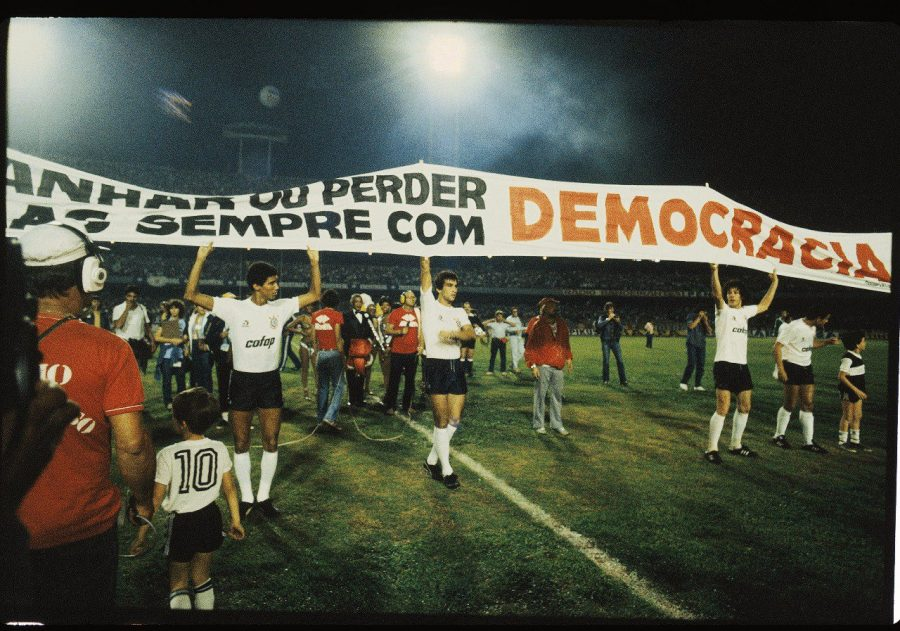
In the 1990s, Uruguayan journalist Eduardo Galeano diagnosed the rot harming modern football in his iconic book, Soccer in Sun and Shadow: “When the sport became an industry, the beauty that blossoms from the joy of play got torn out by its very roots.” Three decades later, things are even worse. The soccer industry is wrapped up with the forces making life materially more difficult for fans around the world, threatening rights and democracy, and driving climate change that is making games unplayable and imperiling communities. When I look at the game and the world today, I see the need for a revival of the Corinthian spirit of leaders from within the sport who recognize their power to change the game and the world it is played in. We see it in the women’s game where there is a long tradition of fighting for inclusion, on and off the pitch. More is needed. It is a lot to ask of a sport, but soccer is the world’s sport, and the world is in desperate need of help right now. Where better for that to come from than the sport that gives so many so much joy? And why not at this summer’s men’s World Cup?
Canada and Mexico are co-hosting the 2026 FIFA World Cup, but the eyes of the world will be on the matches hosted in the US, and not just for what will be happening on the field. There are too many worries hanging over those games. Will fans, staff, and even players be prevented from entering the US? Will the US military show force around the stadiums? Will ICE target fans? Will there be violence?
There is a lot of anger and anxiety surrounding this World Cup, but there is space for something else too: For protest, resolve, and solidarity. What better time for a player, a coach, or a team to take a stand? Or for fans to make alliances that outshine and outlast the tournament? One of the reasons we love soccer is that it can inspire, make us dream, and help us feel part of a team that can do big things. Right now, we all need that feeling.
I have yet to get my hands on a Corinthians jersey, but I did recently acquire a Clapton CFC jersey. Using the designs and the red, purple and yellow of the International Brigades flag from the Spanish Civil War, the shirt incarnates the fan-owned, amateur East London club’s anti-fascist ethos, complete with the inscription of “No pasarán” tucked under the back collar. The shirt is already in heavy rotation in my wardrobe.
When the World Cup kicks off this summer, I will be cheering for Canada’s men’s team, of course. They are my home team, competing at a home-ish World Cup with some excitingly talented players. I would like to see them go far in the tournament, but I have my eye on a few other teams to cheer for as well. Haiti, Curaçao (the smallest country to ever qualify), Cape Verde (the third smallest), DR Congo, Scotland, and frankly any small team with a good story to tell. There are lots of exciting underdogs to support, but whoever plays, I hope to see beautiful soccer on the pitch. I hope to see stunning goals, creative assists, perfectly timed tackles, and impossible saves. I hope to see gutsy longshot wins. But more than all of that, I hope to see the spirit of resistance in soccer reborn. Before the tournament is over, I will no doubt be adding one or two new jerseys to my collection.