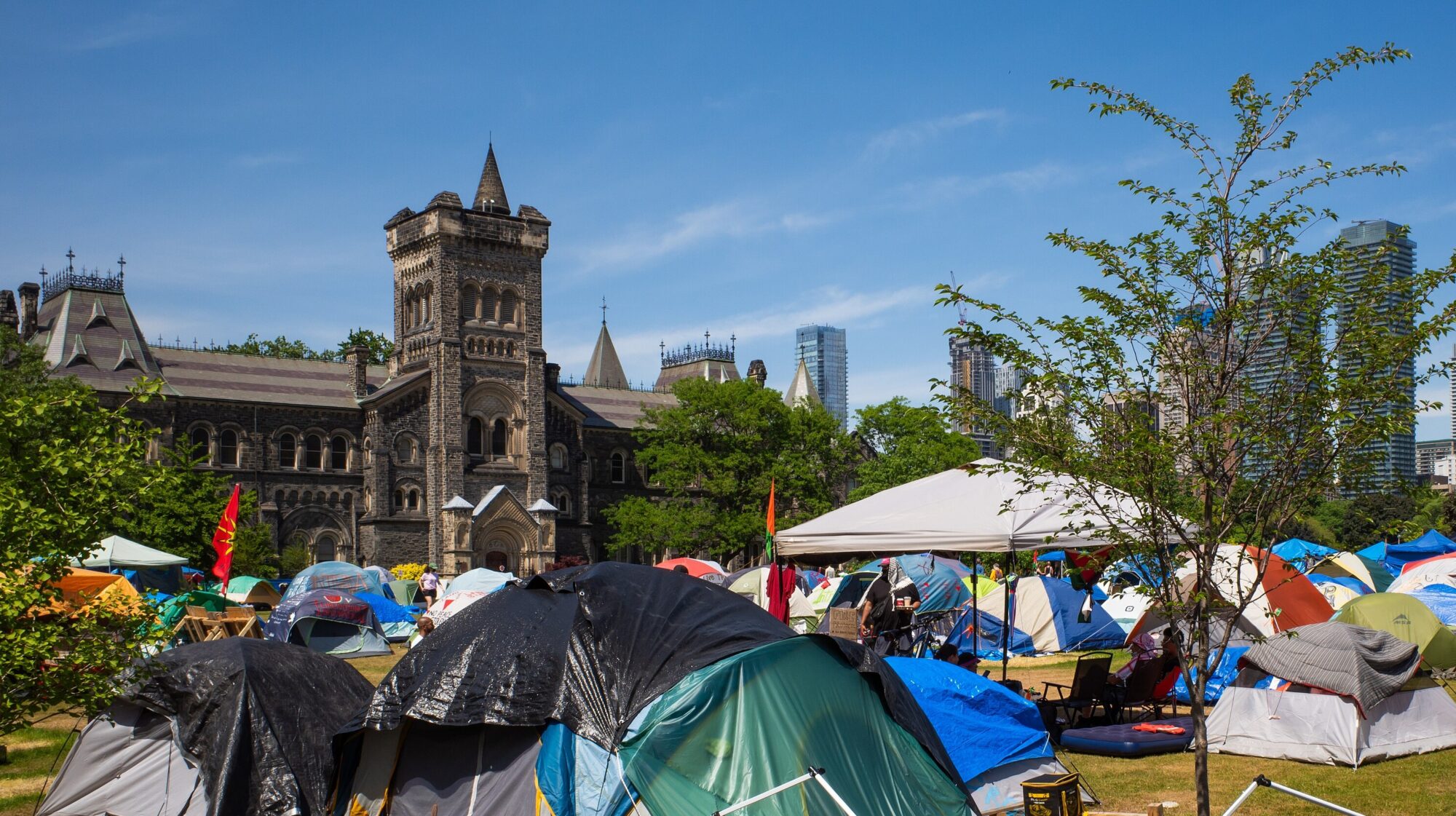
The 2024 People’s Circle for Palestine protest encampment at the University of Toronto is best understood in terms of “contradiction” as the tensions and struggles which make political life. Over its two-month duration, it was neither a unified expression of solidarity nor reducible to a narrative of institutional repression, but a shifting field of forces in which insurgent organizing and institutional authority converged. What emerged from the People’s Circle was a political formation shaped by the interaction of these opposing forces, each delimiting what could be sustained.
The primary contradiction structuring the protest was the relationship between the university and the institution’s investments in imperial violence. The People’s Circle demanded that the University of Toronto disclose its investments linked to the ongoing genocide, commit to divesting from them, and cut ties with Israeli academic institutions while the genocide and occupation continue to destroy Palestinian universities, murder academics, and prevent Palestinian students from studying in Canada. The People’s Circle also contested the contradiction of the university’s management of dissent, including its uneven invocation of ‘safety’ and its escalating reliance on legal instruments such as the issuance of trespass notices and the pursuit of a legal injunction against the protest encampment. Contradiction was evident in the university’s policies, leading to such strong political tensions.
To identify the University of Toronto’s contradictions is not to claim unanimity among the People’s Circle participants, nor to suggest that all actions cohered to a single line. Rather, this identification names the structuring antagonisms that oriented the encampment’s goals. Without orientation, as a horizontally organized protest, collective action would risk dispersal and ineffectiveness. With the identified contradictions lending to orientation, differences can be negotiated among the People’s Circle without dissolving the political project itself.
Yet, the encampment could be equally identified by secondary contradictions. These included disagreements over strategy and uneven relationships to risk shaped by identity, citizenship status, and institutional affiliation, among others. At its peak, the encampment brought together nearly 200 in solidarity with Palestine, many of whom were strangers prior to arrival. While this density enabled a powerful form of collective presence, the urgency of the protest limited the time and capacity for sustained relationship building, which produced friction. Such secondary contradictions operated within the primary antagonism with the institution and often intensified under conditions of external pressure.
An understanding of the tensions and struggles which make political life, however, provided a useful framework for analysis that aided People’s Circle organizing. Secondary contradictions cannot be ignored in the name of unity, nor can they be allowed to displace the primary struggle. The work of organizing was less about resolving disagreement, and more about managing its effects; developing practices that allowed for continued collective action without requiring premature consensus.
It is in this context that solidarity must be rethought. Solidarity at the People’s Circle functioned as a practice of what might be called “suturing”: the stitching together of disparate political positions and experiences. Sutures hold together open wounds that would otherwise come apart, while leaving visible the fractures that made their application necessary. This metaphor departs from more conservative formulations of solidarity that privilege cohesion over contestation. In this traditional view of solidarity, it is a mechanism of social stability, smoothing over difference in the interest of maintaining order.
The encampment made its tensions visible in forming solidarity through its organizing. Solidarity emerged through the negotiation of difference, sustained by a shared orientation toward a structuring antagonism that cannot be reduced to interpersonal disagreement.
The university’s response to the People’s Circle and the development of this sutured solidarity demonstrates the emergence of this dynamic. Alongside securitization measures and legal threats, the administration advanced forms of strategic accommodation to the People’s Circle, most notably by proposing an Institute of Palestinian Studies at the University of Toronto. This accommodation was not an initiative demanded by organizers and introduced at a moment of intensified pressure. Some saw it clearly as accommodation, while others saw the gesture as a concession. Such gestures, outside of the actual demands of the organizers, are best understood as attempts to rearticulate dissent within administratively manageable frameworks. They signal a familiar institutional logic: to absorb insurgent critique at the level of recognition while leaving underlying relations intact.
This moment is also where the encampment exposed the limits of institutional reform under contemporary conditions. Universities in the West are often imagined as sites of critical inquiry. Instead, they are sites of contradiction within a broader construction of imperialism that Aníbal Quijano describes as the coloniality of power, where knowledge production and racial capitalism are mutually constitutive.
At the same time, the encampment generated forms of collective life that cannot be reduced to either success or failure. Practices of care, internal governance, and political education emerged as the struggle and institutional suppression continued. These practices were uneven, at times fragile, but they indicated how movements develop their own infrastructures in the absence of institutional support.
Furthermore, to insist on contradiction as the point of departure is to resist two common tendencies: the romanticization of the encampment as a coherent prefigurative space, and its dismissal as politically ineffective. Neither captures the specificity of what unfolded. The People’s Circle was a site in which contradictions were inhabited, and where the capacity to act collectively depended on the ability to distinguish between antagonisms that structure struggle and tensions that must be worked through within it. In retrospect, this distinction is one I wish we had more deliberately named and held as a collective at the time. Many responses to the institution’s repression unfolded in real time, absent shared infrastructure for processing and accountability for the encampment organizers and participants. It was first anticipated that the encampment at U of T might have lasted only twenty-four hours when it was established. The extended stay and rapid expansion outpaced the ability for organizers to build the relational and political structures needed to navigate these tensions together.
If there is a lesson to be drawn, it is that solidarity demands orientation. Under conditions where institutions function to contain and redirect dissent, the question is less how to eliminate contradiction than how to organize within it, and how to sustain political action without collapsing difference into a false harmony.